In late September and early October 2024, I spent ten days exploring Iceland for the very first time. I wasn’t following a strict itinerary. Instead, I let the light guide me, drifting from black sand beaches to moss-covered lava fields, from golden sunrises to nights under the northern lights.
I focused mainly on the south and west of the country, searching for quiet places, unique textures, and moments that felt suspended in time. Autumn in Iceland is short but powerful. The colours are subtle, the days are crisp, and the changing weather turns every scene into something unexpected.
In this guide, I share six of my favourite places and photographic moments from the journey, a mix of iconic locations, quiet discoveries, and one unexpected encounter that stayed with me. You’ll find Google Maps links, planning tips, and insights on how I composed and photographed each scene with my camera.
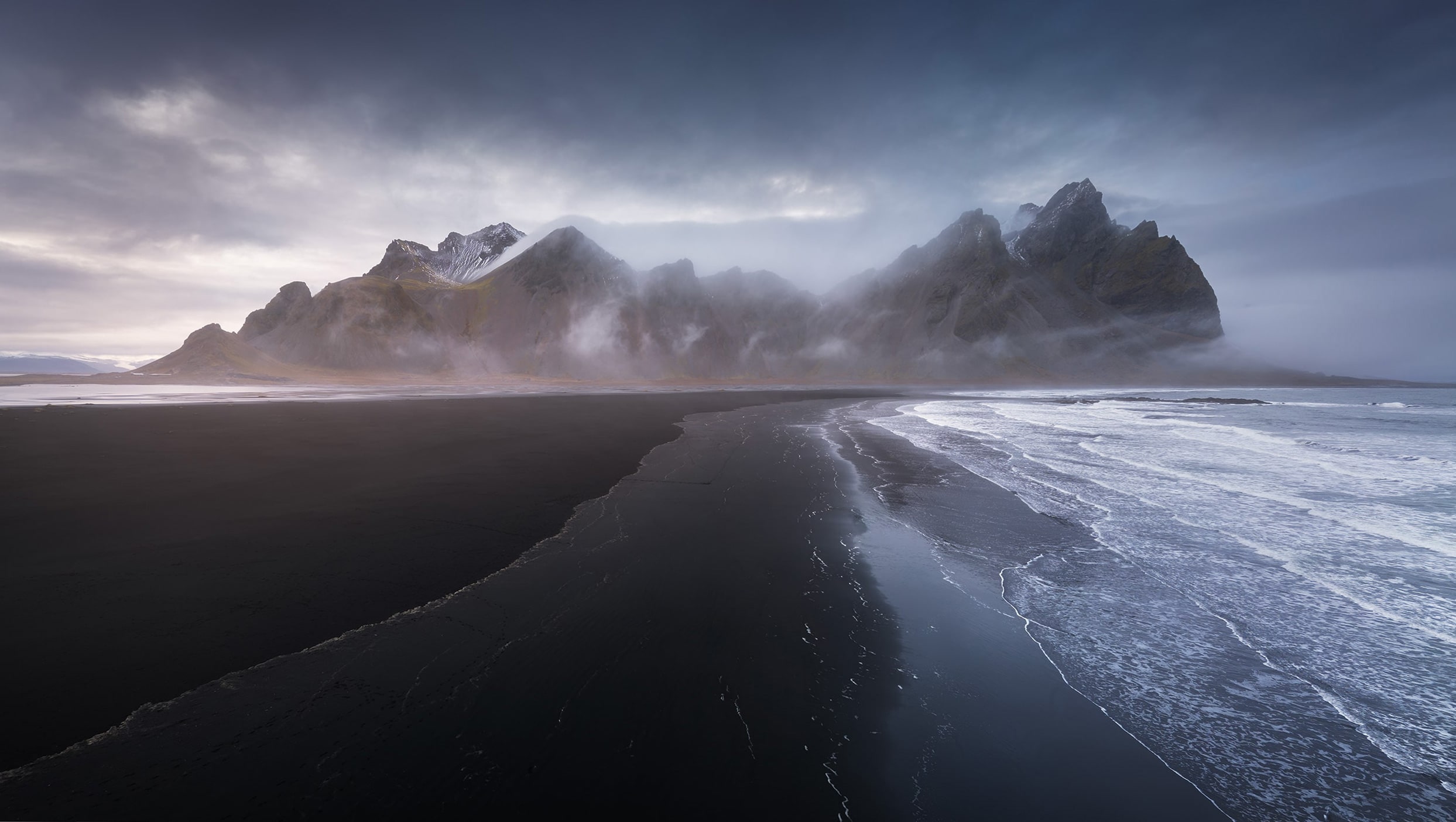
Stokksnes and Vestrahorn : moody panorama from the air
Stokksnes black sand beach had been on my photography list for years. So when I finally planned my trip to Iceland, it was right at the top. We arrived in the late afternoon, hoping for a colorful sunset, but instead we were greeted by a soft, moody light. The sky was covered in fast-moving clouds, their shapes shifting constantly. There was no wind, no rain, just that quiet, moody atmosphere that makes Iceland feel so unpredictable and alive.
At first, I walked along the beach with my Nikon, looking for compositions along the shoreline. But then I noticed the light getting stronger over the ocean side. The sea, the dunes, and the mountains all aligned in a beautiful balance, so I decided to send the drone up. It was the perfect moment for a wide panorama.
How to get there
To access the beach, you’ll need to pay an entrance fee: 800 ISK per person in 2024. You can buy your ticket at the small café located at the main car park. I bought two, just in case I wanted to come back for the northern lights. Be aware that the QR code only works once, so you will need a second ticket for a return visit.
Once inside, there are two parking areas closer to the beach where you can stop and walk from there.
How I photographed this scene
At first, I wasn’t planning to fly the drone. I was walking on the beach, composing shots of the waves and the dark sand with my Nikon. But as the light started getting interesting on the left side of the beach, I realized it was a perfect opportunity to capture the scene from above. The wind was low, the light was soft, and the mountains looked beautiful from the air. I created a vertical panorama from five frames, showing the contrast between the sea and the dramatic shapes of Vestrahorn.
My gear
✅ DJI Mini 3 Pro

Kvernufoss : panorama from behind the waterfall
Not far from the famous Skógafoss lies Kvernufoss, a quieter and more intimate waterfall tucked into a narrow canyon. The walk is short and easy, and when you arrive, the view is already stunning, but the real magic happens when you walk behind the waterfall.
Standing there, inside the cave, watching the waterfall in front of you like a translucent curtain, is an unforgettable experience. It’s the kind of place that invites you to slow down, breathe in the mist, and feel the raw power of nature just a few meters away.
How to get there
There’s a parking lot right near the start of the trail. From there, it’s about a 15-minute walk on a relatively flat and easy path. Despite its proximity to Skógafoss, Kvernufoss felt much quieter. I don’t know if it was luck or timing, but we only saw a few people during our visit.
➜ Parking location
➜ Kvernufoss access info
How I photographed this scene
This panorama is a bit of a classic, but I wanted to try it for myself. Even if it’s not the most original idea, I’ve always loved this spot and I wanted to create my own version of it. I used my 24 mm lens, which wasn’t wide enough to capture the whole cave in one shot, so I had to improvise.
I took about 50 overlapping photos, making sure to keep a 30% overlap between each frame to help Photoshop stitch them together. It wasn’t perfect, but it worked. The result is a moody, immersive view of the waterfall from behind. The sky wasn’t dramatic that day, but I still love the quiet atmosphere in the final image. It feels like Iceland.
My friend stood still for the last frame, adding a small human presence to this powerful natural scene.
My gear
✅ Nikon Z8
✅ Nikkor 24–70 mm
✅ Manfrotto tripod

Kirkjufell under the northern lights
Kirkjufell, the famous arrow-shaped mountain on the Snæfellsnes Peninsula, was high on my list of dream locations in Iceland. It’s one of the country’s most iconic landmarks, and I had always imagined capturing it under the northern lights.Autumn is already a great season for aurora chasing in Iceland : the nights are dark enough, and the temperatures are still bearable, so I booked three nights in the area, hoping that at least one evening would offer clear skies and some magic overhead.
How to get there
There are several places where you can photograph Kirkjufell, but for this shot, I chose the shoreline viewpoint, rather than the classic waterfall spot. I had already visited the waterfall at sunset, and for the aurora, I wanted a more minimalist composition : the mountain, the sea, and the sky.
➜ Parking location
How I photographed this scene
I was at a restaurant when I got the aurora alert. Luckily, we had just paid the bill, so we rushed to the car and drove straight to the viewpoint. It was only a few minutes away, but when we arrived, the shoreline was already lined with tripods. I managed to squeeze into a small open spot and set up quickly.The wind was strong and the clouds were moving fast. I only had about 15 minutes before the aurora disappeared behind the clouds. I kept the composition simple : a bit of sea in the foreground, Kirkjufell in the center, and the soft green lights dancing in the background.
My gear
✅ Nikon Z8
✅ Nikkor 24–70 mm
✅ Peak Design tripod
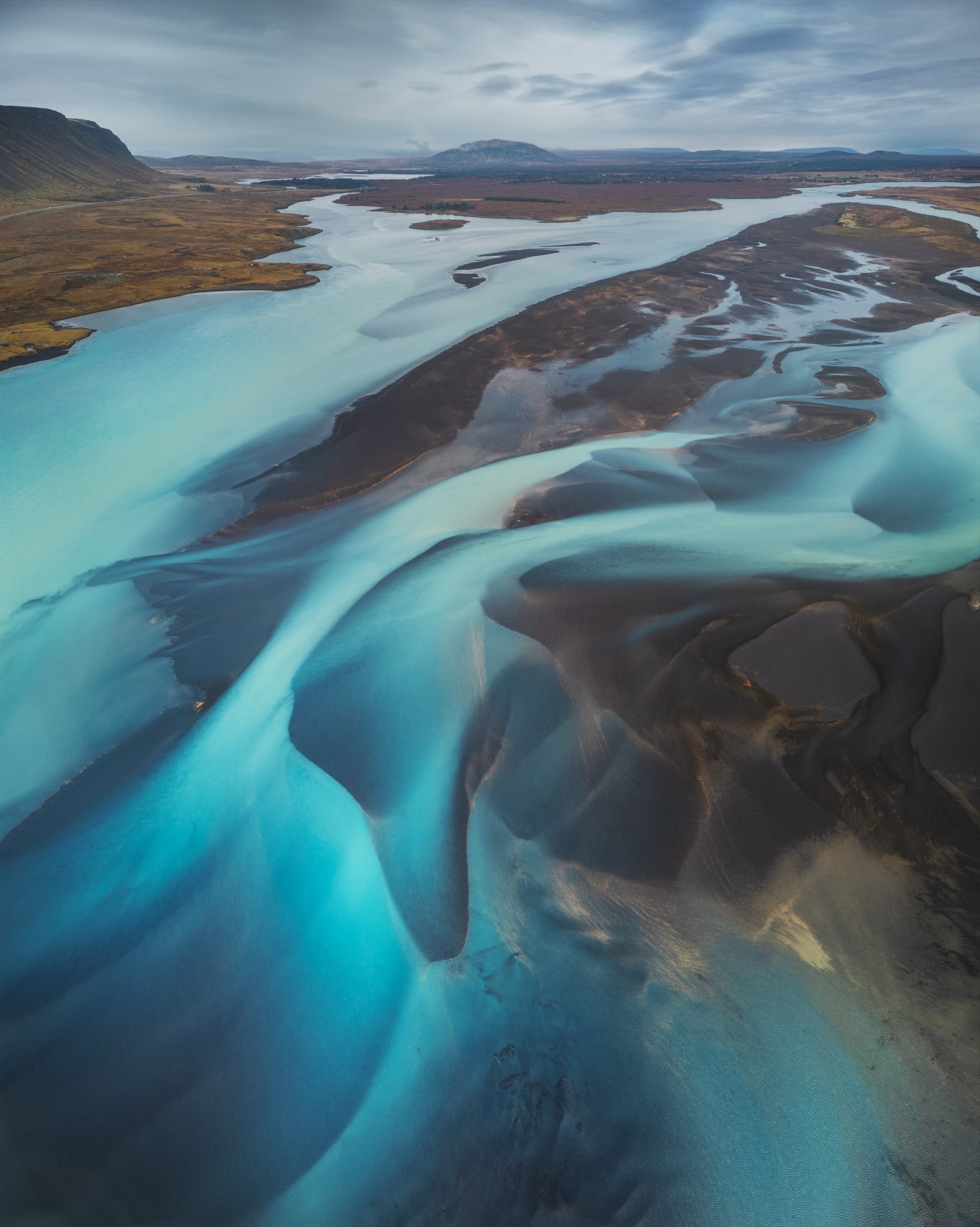
Braided river near Selfoss : textures from above
For me, Iceland also meant braided rivers. We have a few in Switzerland, mostly at the end of glaciers, but they’re small and often hard to access. In Iceland, I knew I’d finally get the chance to see them on a grand scale. I spent time in advance selecting possible spots, trying to find locations where I could safely launch my drone. With a DJI Mini 3 Pro, I wanted to stay close to the car and avoid flying too far.The south of Iceland is full of braided rivers, and once you start spotting them from the road, it becomes impossible to ignore their beauty. This one, near Selfoss, was one of my favorites.
How to get there
This braided river is located about one hour east of Reykjavík, close to the town of Selfoss. You won’t find a marked parking area, so the key is to watch carefully for a safe spot to stop your car along the road. I had picked a location on Google Maps ahead of time, but when I arrived, it wasn’t accessible. So I took a bit of time to explore and eventually found a secure area near the riverbed.
➜ Braided rivers
How I photographed this scene
This is a panorama made of four horizontal images, stitched together in Photoshop. I deliberately went there on a cloudy morning to avoid harsh reflections on the water, and I got lucky : the light was soft, the sky overcast, and the wind almost absent. The patterns in the river were clear and beautifully defined, just like I had imagined.From the ground, it’s nearly impossible to guess if the scene will look interesting from above. I relied on Google Maps satellite views to choose this spot and was hoping to see those turquoise blue channels and intricate textures. And this time, it worked.
My gear
✅ DJI Mini 3 Pro

Icelandic foals in the autumn light
As a lifelong horse lover, I dreamed of seeing Icelandic horses up close. Before the trip, I was a little worried I might not come across them easily. But I quickly learned that in Iceland, horses are everywhere. You’ll see them grazing peacefully in fields all along the roads.That said, it’s important to approach them with care. These horses all belong to someone. They are not wild, and they are not there for tourists. If you stop to take pictures, always park safely and respect the land, the fences, and the animals. Never feed them or try to lure them closer.
How I photographed this scene
I was looking for horses in good light, close enough to the road, and near a safe place to park. It sounds simple, but finding the right combination took a few days. One afternoon, the light was perfect, soft and warm, and I found these two foals standing close together, cuddling in the golden grass.The darker one lifted its head and looked straight at me, its fur glowing with backlight. The colours of the scene, the warm browns of the horses, the autumn tones in the grass, the quiet atmosphere, all came together for a photo that felt soft and peaceful. Just as I had hoped.
My gear
✅ Nikon Z8
✅ Nikkor 70–200 mm

Reynisdrangar seastacks : long exposure magic on black sand
Located near the village of Vík, Reynisdrangar is one of Iceland’s most iconic coastal formations. Rising like sharp silhouettes from the Atlantic Ocean, these dramatic sea stacks have been sculpted by centuries of wind and waves, and are surrounded by legends. Needless to say, I had to go and capture them with my camera.
How to get there
The beach is very easy to access. There’s a large parking lot right next to the shore, just a few minutes from Vík. Because it’s a famous landmark, it tends to attract crowds, so we decided to go early, during low tide, to enjoy a bit of space and walk along the beach. Be very careful here, the waves can be extremely powerful and unpredictable. Never turn your back to the sea.
How I photographed this scene
That morning, the sky wasn’t particularly dramatic. There were no vibrant colors or stormy clouds, just a light haze in the air and powerful crashing waves. So I changed my plan and decided to go for a long exposure. I wanted to turn the ocean into a soft mist and create a minimal, almost ethereal version of this famous place.The sea stacks lost their details in the fog, giving the image a ghostly atmosphere. The soft light combined with the long exposure created a subtle contrast between the white water flow and the black sand. To slow down the shutter speed enough, I used a ND1000 filter, which allowed me to capture the motion of the sea without overexposing the shot.
My gear
✅ Nikon Z8
✅ Nikkor 24–70 mm
✅ Peak Design tripod
✅ ND1000 filter
A personal journey through Iceland’s wild beauty
Exploring Iceland in the fall was a dream come true. From the dramatic black sand beaches of Reynisdrangar to the delicate patterns of braided rivers near Selfoss, each location offered something unique for landscape photography. The golden grasses, soft light, early nights, and ever-changing weather made this season both challenging and rewarding to photograph.
Whether you’re chasing the northern lights over Kirkjufell, walking behind a waterfall at Kvernufoss, or watching Icelandic foals in the wind, there’s magic in every corner of this country. I hope this guide helps you plan your own photography trip to Iceland and inspires you to look for moments that feel true to your vision.
And most of all, enjoy the moment. Happy shooting.
Published on January 16, 2026 by Jennifer Esseiva