Seeing the northern lights has been a dream of mine since childhood. In recent years, I started traveling north more often to give myself more chances to witness this phenomenon that had fascinated me for so long.
From Iceland to Lapland, Norway, and the Faroe Islands, I’ve been lucky enough to see and photograph the aurora borealis in many different colors, from the familiar green glow to rarer shades of pink, purple, yellow, and even blue.
During exceptional solar storms, I also witnessed rare red and green auroras from Switzerland. Seeing the sky turn red so far south remains one of the most powerful moments of my photography journey.
In this article, I share my favorite northern lights photographs and the stories behind them, while explaining why auroras appear green, pink, purple, red, yellow and blue, and how rare each color can be.
If you’re interested in learning how to anticipate, photograph, and adapt to these conditions in the field, I share my complete approach in my in-depth guide to northern lights photography: Essential tips for northern lights photography
What Color Are the Northern Lights?
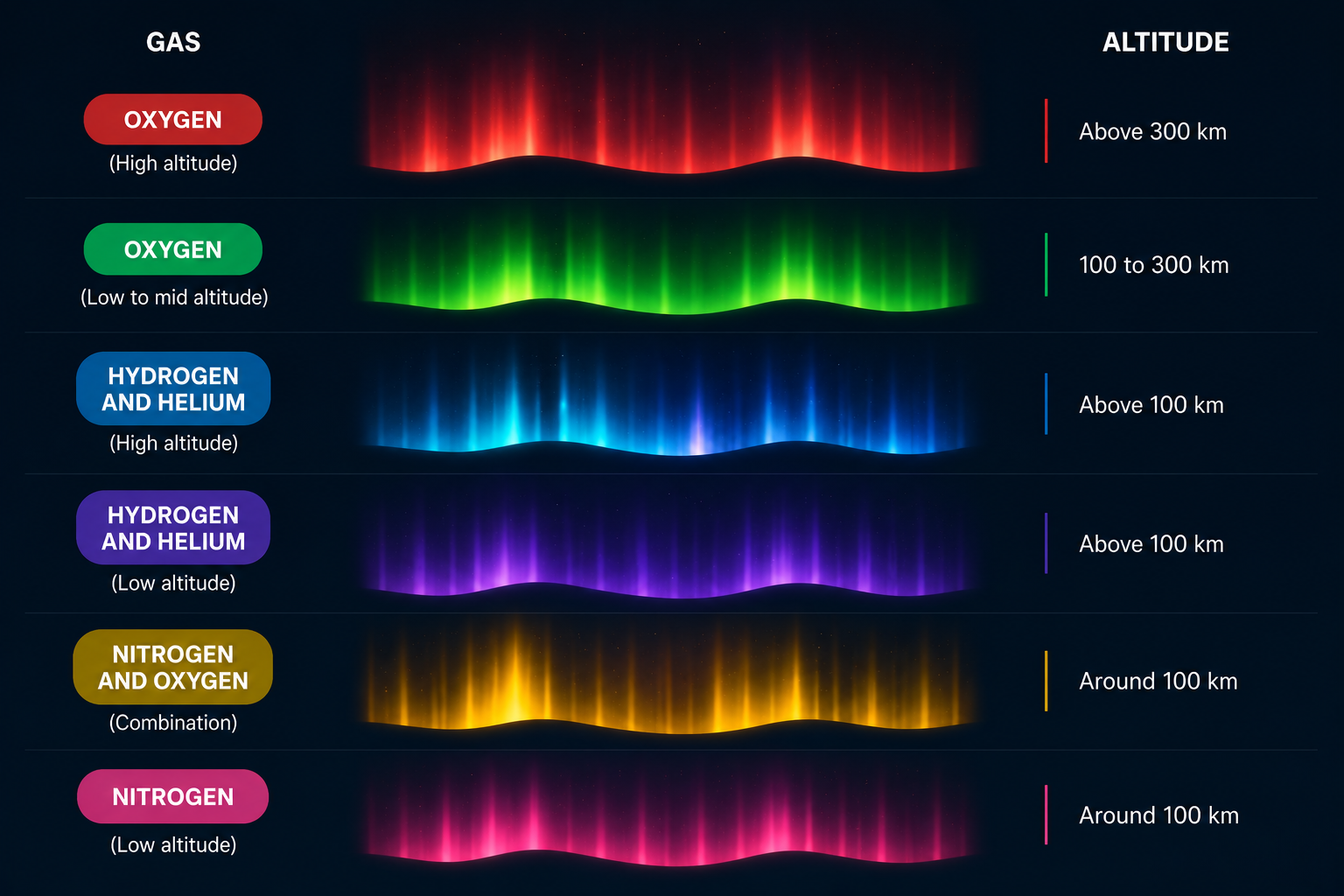
Northern lights can appear in several different colors, including green, pink, purple, red, yellow and blue. Green is by far the most common aurora color, while red and blue are among the rarest. These colors are created when solar particles interact with oxygen and nitrogen in the Earth’s atmosphere at different altitudes. The stronger the solar storm, the greater the chance of seeing unusual colors beyond the familiar green glow.

Camera settings : ISO 2500, f/4.5, 20 seconds
Green Northern Lights: The Classic Aurora Glow
📍 Lapland, Sweden
Green is the most frequently seen aurora color and often dominates the sky during geomagnetic storms. It appears when energetic particles collide with oxygen atoms at altitudes between 100 and 300 km.
Why green?
✅ Caused by: oxygen atoms
✅ Altitude: 100–300 km
✅ Typical during: moderate to strong KP storms
The story behind this shot
This was the very first aurora I ever saw and photographed. It was captured in Swedish Lapland, near Kiruna, during a full moon night.
I remember how excited I was. Every evening, I kept looking at the sky, hoping to finally see the northern lights, but the clouds never seemed to leave. Night after night, nothing happened.
Then one evening, everything aligned. Our guide took us to a frozen lake, far from any light pollution. At first, I couldn’t see anything at all. The sky looked quiet and empty. And then, slowly, a faint green curtain began to move.
That moment is etched in my memory. Standing there, in complete silence, watching the aurora dance for the very first time, I knew a dream had just come true.

Camera settings : ISO 2500, f/2.8, 13 seconds
Pink Auroras: A Sign of Powerful Solar Storms
📍 Kirkjufell, Iceland
Pink auroras are less common and usually appear during strong auroral displays. They often form above green bands or blend with violet tones, creating a vivid and intense atmosphere in the sky.
Why pink?
✅ Caused by: nitrogen and oxygen interaction
✅ Altitude: approximately 100–200 km
✅ Often seen during strong solar storms
The story behind this shot
During my time in Iceland, I experienced six nights of northern lights out of ten. It felt almost unreal. When planning the trip, I made sure to spend several nights near Kirkjufell, on the Snæfellsnes Peninsula, hoping for strong activity.
From the very first nights, the aurora was intense, forming tall, vertical pillars above the landscape. I was both excited and nervous, afraid it might disappear at any moment before I could fully capture it.
But the display lasted longer than expected. Watching pink auroras dance above such an iconic Icelandic landscape was an unforgettable experience, and one of the most powerful moments of the entire trip.
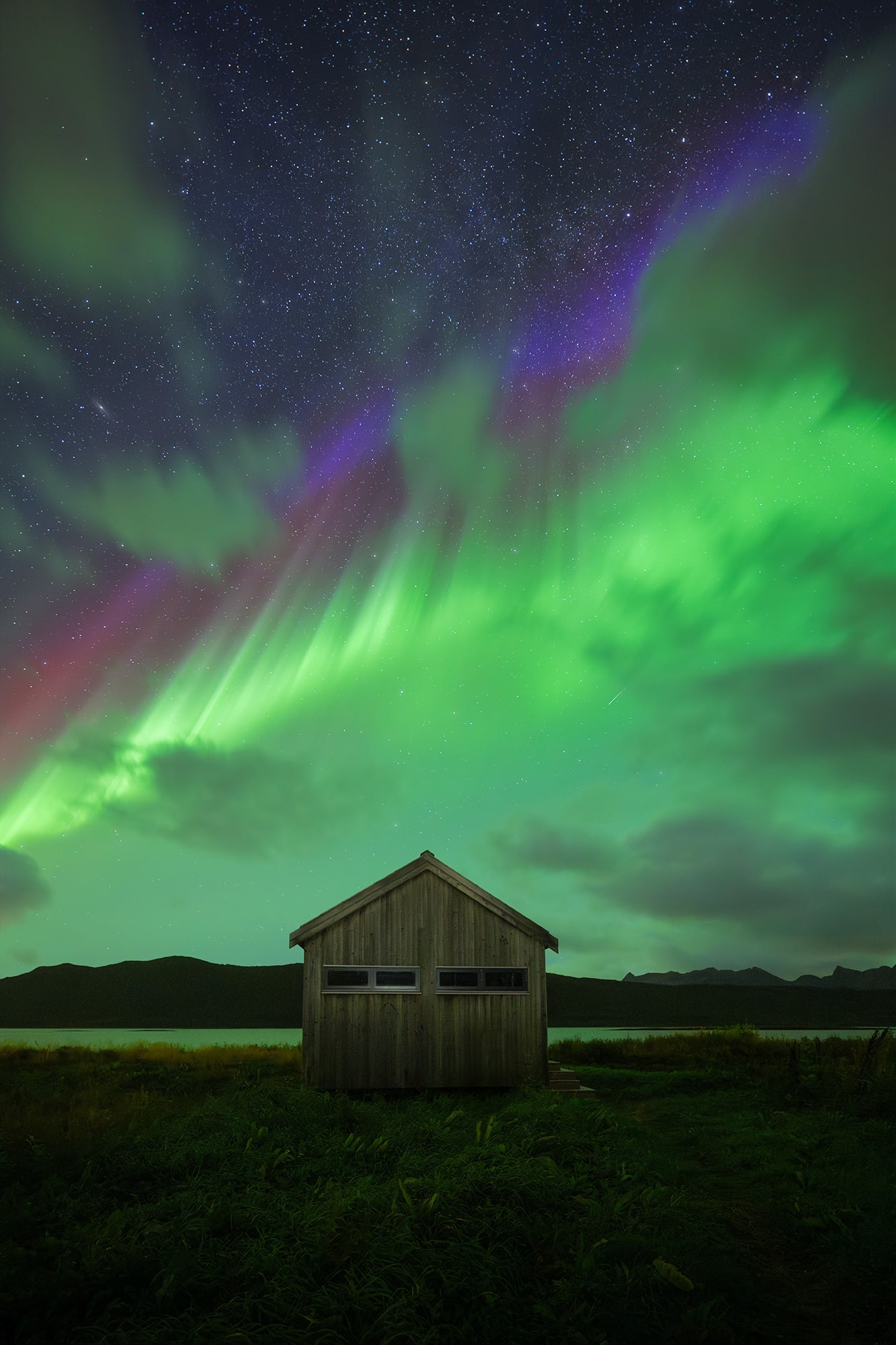
Camera settings : ISO 3200, f/2.8, 10 seconds / ISO 3200, f/2.8, 20 seconds
Purple Auroras: The Mysterious High-Altitude Dance
📍 Engeløya, Northern Norway
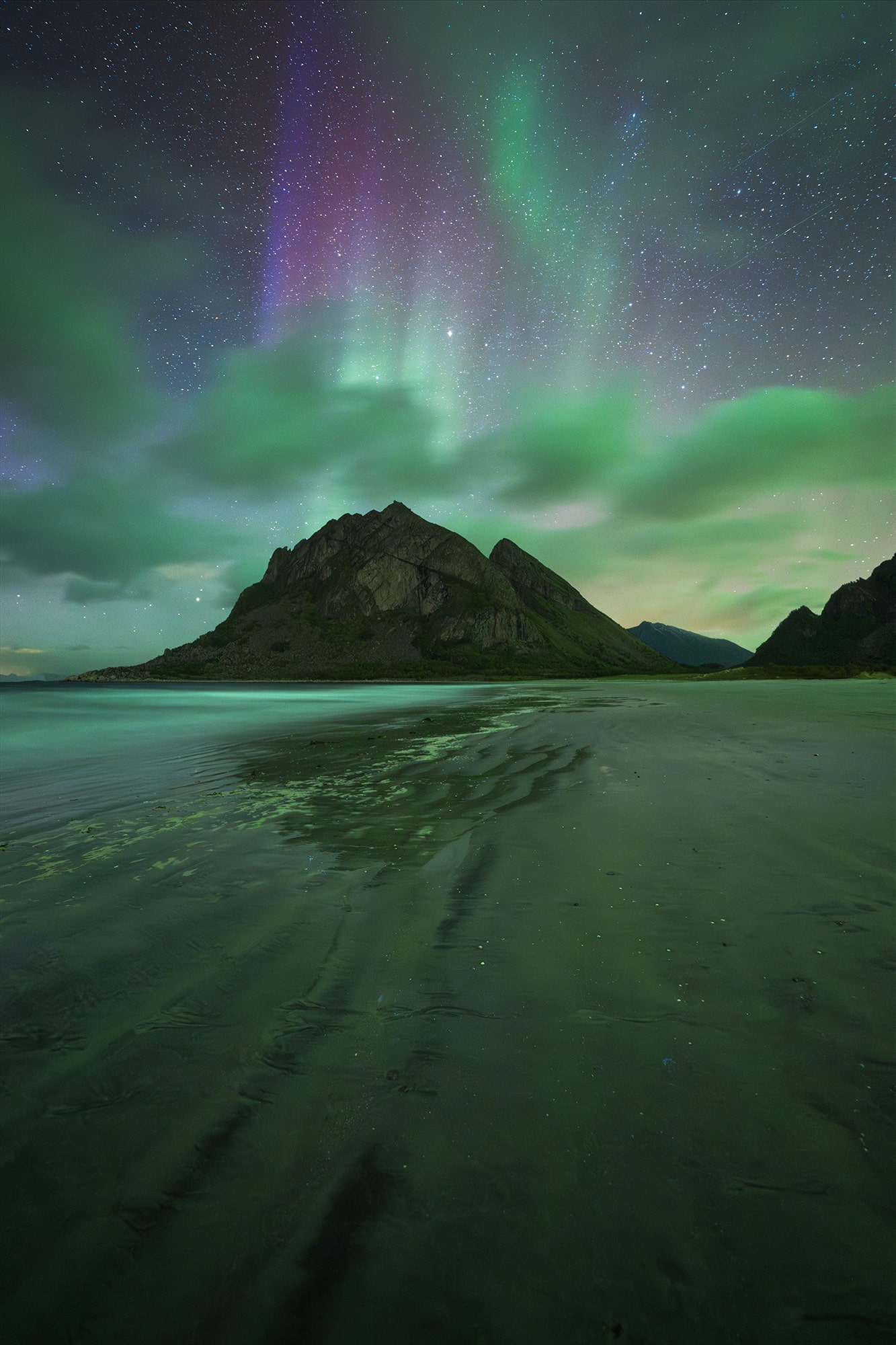
Purple auroras are less common and usually appear during strong auroral displays. They often form above green bands or emerge when auroral activity intensifies, creating deep, vivid colors that can change within seconds.
Why purple?
✅ Caused by: nitrogen molecules
✅ Altitude: above 300 km
✅ Often seen during strong solar storms
The story behind this shot
I was staying in the Steigen region of Northern Norway, on Engeløya. The weather had been freezing cold and cloudy, and I wasn’t sure I would get a real chance to see the northern lights, but I kept hoping.
When night fell, a few stars appeared through the clouds. I put on my warmest clothes and drove straight to Bøsanden Beach.
The clouds were moving fast when I arrived, so I rushed to set up my tripod. The aurora suddenly appeared above the dark sea, first in green and soft pink tones. Within seconds, the colors intensified and shifted into deep purple hues layered with green.
I managed to capture a few frames before the rain started. Thinking the night was over, I headed back to the cabin, but the sky cleared once more. The aurora was still strong, giving me just enough time for a few final images with the cabin I was staying in before the clouds closed in again.
Camera settings
ISO 31, f/22, 5 seconds

Camera settings : ISO 4000, f/2.8, 10 seconds
Yellow Northern Lights: A Rare Blend of Red and Green
📍 Lofoten, Norway
Yellow auroras are not a distinct emission, but rather the result of green auroral light mixing with red or white tones. They tend to appear when auroras are low and diffuse, or during longer exposures, which can reveal colors that are barely visible to the naked eye.
Why yellow?
✅ Blend of: green and red light
✅ Often enhanced in photographs due to exposure and color balance
✅ Rare to the naked eye, but striking in-camera
The story behind this shot
It was my last night in the Lofoten Islands. A friend suggested we drive to a specific spot in Hamnøy, overlooking the Reinefjord, hoping for a final chance to see the northern lights.
The sky was cloudy, once again. We waited for about twenty minutes in the cold, watching the clouds move while leaving occasional openings in the sky. Then the aurora slowly began to appear.
At the time, I didn’t realize the colors were turning yellow. To my eyes, the scene looked subtle and almost monochrome. What I did notice immediately, though, was a shooting star crossing the sky. I turned to my friend and said, “Oh my god, did you see that?”
I waited patiently for the exposure to finish. When I looked at the image on the back of my camera, I couldn’t believe it. A yellow aurora captured together with a shooting star.
In that moment, I knew. This was the shot of the trip. We could go to sleep.
Camera settings
ISO 31, f/22, 5 seconds
Camera settings : ISO 2500, f/2.8, 8 seconds
Red Auroras: A Rare and Powerful High-Altitude Glow
📍 Lac de Bret, Switzerland
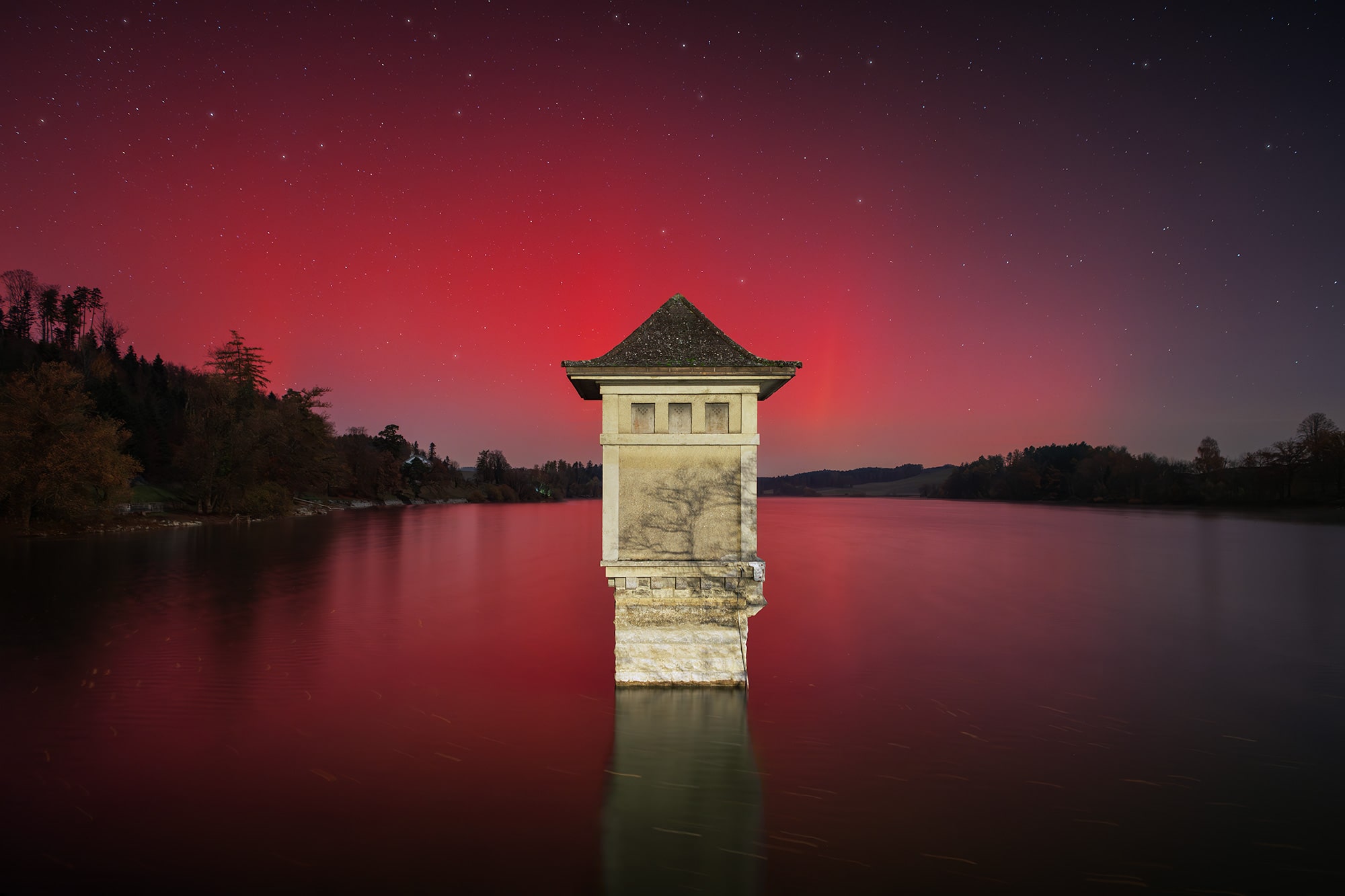
Red auroras are among the most striking and unusual aurora colors. They typically appear during very strong geomagnetic storms and glow high above the Earth, often spreading slowly across the sky. Unlike fast-moving green auroras, red auroras tend to feel calmer, deeper, and almost atmospheric.
They are usually visible at high altitudes, where oxygen atoms emit red light when excited by energetic solar particles. Because of their altitude and diffuse nature, red auroras can sometimes be seen far south of the Arctic Circle during intense solar activity.
If you’d like to see how rare red and pink auroras can appear in Switzerland, you can read my dedicated article on northern lights in Switzerland.
Why red?
✅ Caused by: oxygen atoms
✅ Altitude: above 300–400 km
✅ Seen during: strong to extreme geomagnetic storms
The story behind this shot
On November 12, 2025, I captured one of the most intense auroras I’ve ever seen in Switzerland. It was only the second major aurora I had the chance to photograph from my home country.
When I checked the forecast that night, I hesitated only briefly. I woke up at 3:30 a.m. and decided to give it a try. Sometimes, you simply feel that the conditions are worth the risk. I’m grateful to a friend who encouraged me to go, she was absolutely right.
When I arrived at the lake, the sky was already glowing deep red. That instant was unmistakable. I knew immediately that I wasn’t too late. I chose this location because it’s close to home and offered the possibility of reflections on calm water, something I had been hoping for.
Standing there in the silence of the early morning, watching the red aurora stretch across the sky, felt like a gift. Moments like these are rare, fragile, and unforgettable. Northern lights remain the most powerful natural phenomenon I’ve ever witnessed.
Camera settings
ISO 31, f/22, 5 seconds
Camera settings : ISO 1600, f/3.2, 15 seconds
Blue Auroras: The Rarest Color of All
📍 Faroe Islands
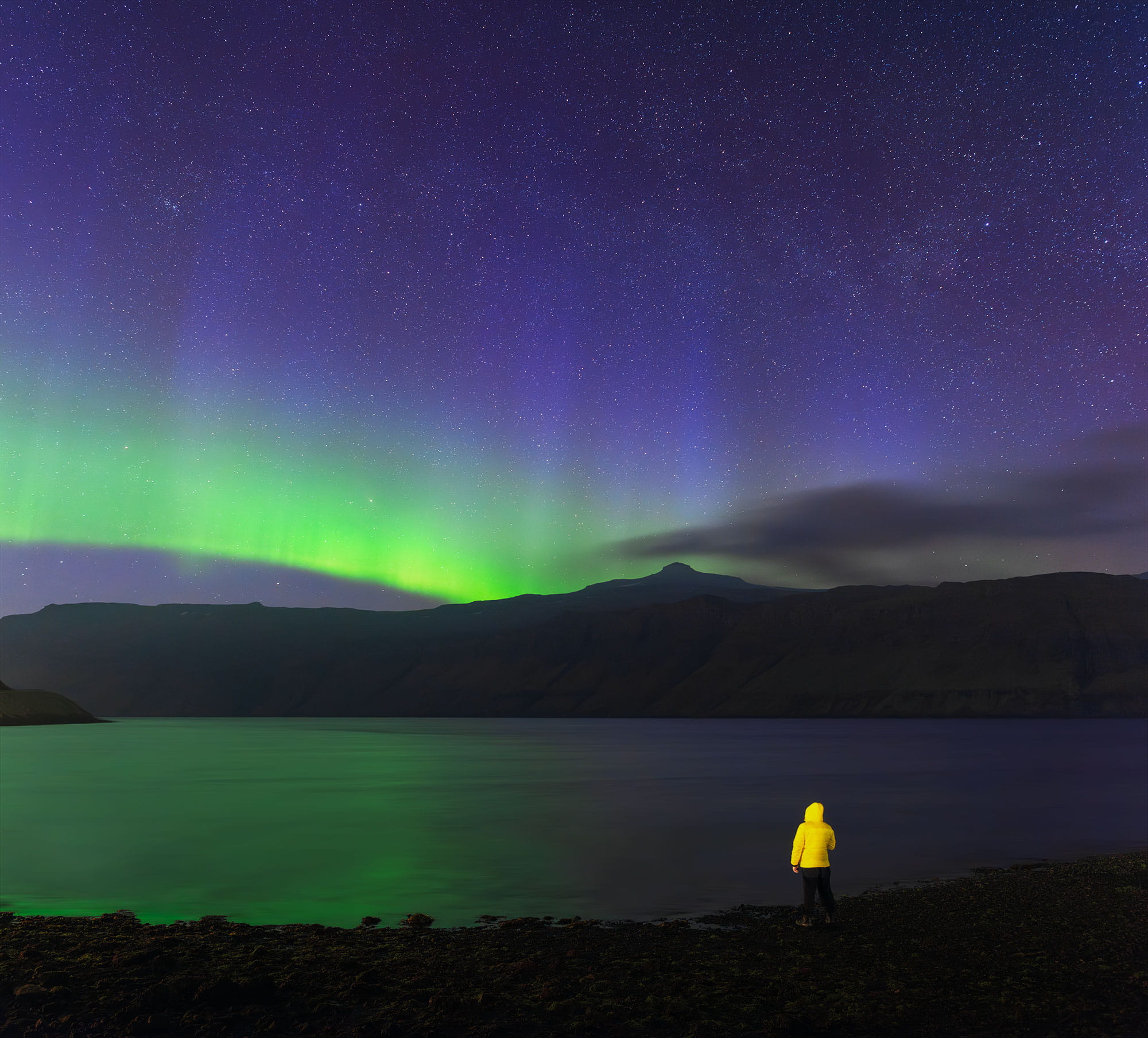
Blue auroras are considered the rarest of all aurora colors. They are caused by interactions with nitrogen at very low altitudes, typically below 100 km. Because they form so close to the Earth and are often masked by stronger green emissions, blue auroras are extremely difficult to observe with the naked eye.
They usually appear only during strong geomagnetic storms, when auroral activity is intense and layered. In many cases, the blue tones become visible mainly through long exposures rather than direct observation.
Why blue?
✅ Caused by: nitrogen at very low altitude
✅ Altitude: below 100 km
✅ Extremely rare and often invisible to the naked eye
✅ Appears during strong geomagnetic storms under optimal conditions
The story behind this shot
It was our last night in the Faroe Islands. The conditions looked promising, and even though the Faroe Islands are not known as an ideal destination for aurora sightings, I couldn’t help but hope. Cloudy weather often makes aurora photography there unpredictable.
I was inside our cabin when I noticed a faint glow in the sky. My friend was already in his pajamas when I told him. We quickly put on our jackets and walked down to the shoreline right next to the cabin, just to see if it was worth setting up the camera.
He stepped outside wearing a bright yellow jacket, and I immediately imagined the scene. I wanted a photograph of him standing beneath the northern lights, adding a human scale to the landscape.
At the time, I had no idea how rare this aurora truly was. It was only later, back home, when I opened the image in Camera Raw, that I realized what I had captured. The aurora wasn’t just green. It was blue and green.
Seeing such a rare color combination, captured almost by chance in the Faroe Islands, still feels unreal.
Camera settings
ISO 31, f/22, 5 seconds
Final thoughts
The aurora borealis is never the same twice. Its colors, shapes, and movement are constantly changing, shaped by altitude, atmospheric conditions, and solar activity. Witnessing these different hues, from familiar green to rare blue and deep red, has been one of the most meaningful parts of my photography journey.
Understanding why auroras appear in different colors adds another layer to the experience. But beyond the science and the images, what stays with you is the feeling of being there. Standing in the dark, waiting in silence, watching the sky slowly come alive.
If this article inspires you to look up, to wait a little longer, or to chase the light with more curiosity and patience, then it has done its job.
If you’d like to explore this theme further through a more artistic and curated selection of images, you can discover my dedicated aurora photography series, Boreal Dreams.
And most of all, enjoy the moment. Happy shooting.
Published on February 13, 2026 by Jennifer Esseiva