In 2012, I set out on a month of Chile and Bolivia travel photography, a solo route from the Altiplano to the Pacific. After two months in Santiago learning Spanish, I crossed the Atacama, the Bolivian highlands and Uyuni, then headed south to Chiloé and Frutillar, before ending on Easter Island. A journey of light, silence and slow exploration.
I booked a three-month stay in Chile. For the first two months, I lived in Santiago and took Spanish lessons. I had always wanted to explore South America, and learning the language seemed like a good way to feel more at home there.
For the final month, I planned a solo journey across the country. I started in the north, in San Pedro de Atacama, to visit the Valle de la Luna and the high-altitude lagoons. Then came a five-day trip through the Bolivian Altiplano, all the way to the Salar de Uyuni.
Back in Chile, I travelled south to Chiloé Island and Frutillar, where I hoped to see the snow-capped Osorno volcano. And to end the journey, I flew to Easter Island, a place I had dreamed of for years, and met wild horses roaming near the ancient moai.
Quick guide: 7 landscapes to photograph in Chile and Bolivia
A month across deserts, volcanoes, oceans and remote islands. Here are seven powerful locations that combine light, silence and emotion, through the lens of a solo traveler:
➜ Valle de la Luna : golden rocks glowing at sunset in the Atacama Desert
➜ Laguna Miscanti : bold contrasts of blue sky and orange earth
➜ Altiplano Boliviano : wild textures and dramatic clouds in high altitude landscapes
➜ Salar de Uyuni : salt lines and endless reflections from Incahuasi
➜ Muelle El Caleuche, Chiloé : green islets in a wild sea, moody and windswept
➜ Frutillar beach : a quiet lake view with Osorno volcano at blue hour
➜ Ahu Tongariki, Easter Island : black and white harmony of moai and wild horses
Whether you’re looking for new inspiration or dreaming of your first journey to South America, I hope this list encourages you to explore slowly and shoot with feeling.
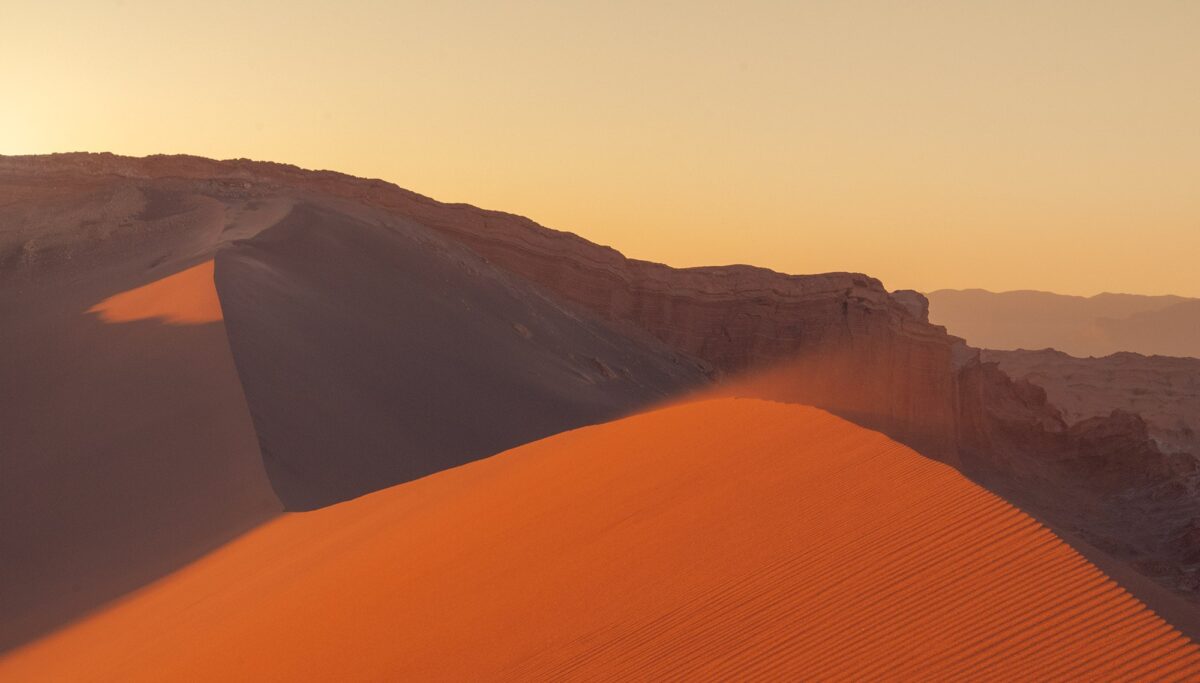
Valle de la Luna: sunset light over the Atacama
📍San Pedro de Atacama, Northern Chile
San Pedro de Atacama is one of the main gateways to the Norte Grande. It was my starting point in northern Chile and one of the places I was most excited to explore. The Valle de la Luna had long been on my list, and visiting it felt almost symbolic, as I happened to go there on my birthday.
It was the first time I had ever seen a desert. I didn’t feel confident enough to rent a car alone in such an unfamiliar environment, so I joined a small group tour that left in the late afternoon to catch the golden hour. That turned out to be a perfect decision.
We arrived as the sun began to drop closer to the horizon. The entire landscape slowly shifted from pale earth tones to deep orange and soft pink. The rock formations seemed to glow from within. I remember standing in complete stillness, watching the shadows stretch across the valleys. It felt like being on another planet. And truly, it was one of the most beautiful places I had ever seen.
Best time to photograph
Golden hour is ideal, whether in the morning or evening. That’s when the colors come alive, the shadows grow long, and the textures become more defined. The rocks seem to breathe. It might also be interesting to try a night session under moonlight.
➜ Valle de la Luna (Duna Mayor)
Access and tips
I joined a guided tour from San Pedro de Atacama, as I wasn’t comfortable renting a car on my own. Most agencies in town offer sunset excursions. I recommend checking Google reviews to choose a trusted operator.
✅ Protect your gear. Fine dust and wind are common, so avoid changing lenses outside.
✅ Bring both a wide-angle lens for sweeping views and a zoom to capture rock textures and isolated shapes.
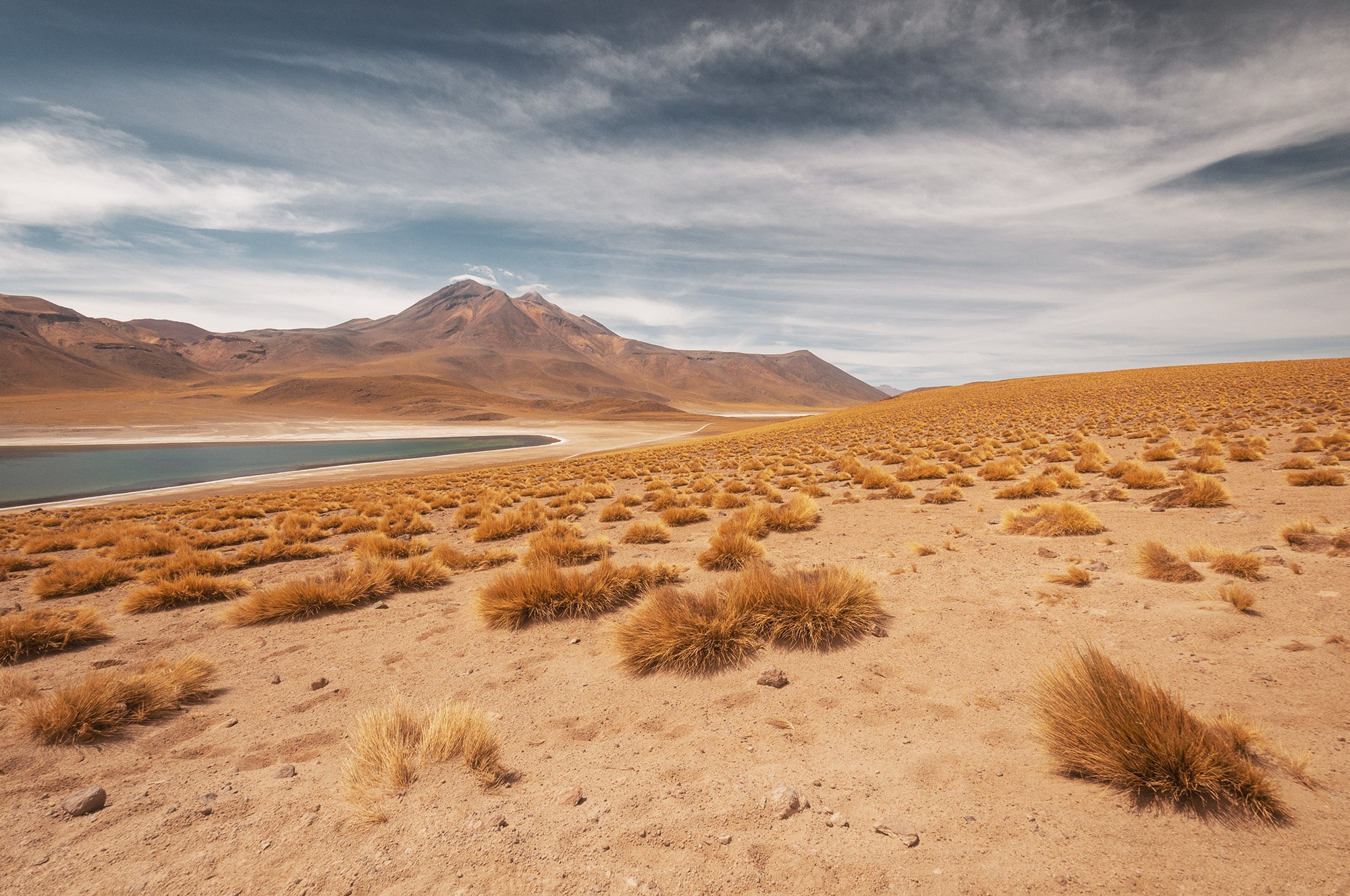
Laguna Miscanti: high-altitude colors
📍Antofagasta Region, Northern Chile
One of the things I was most excited to see in the Atacama was the famous high-altitude lagoons. I had initially booked a trip to the Bolivian side to visit some of them, but the national park was closed due to protests. As an alternative, I joined a tour to Laguna Miscanti and Laguna Miñiques, two stunning lakes located about an hour and a half from San Pedro de Atacama.
The tour was well-organized, and once on site, we had plenty of time to walk around and take photos. These lagoons are located at around 4,200 to 4,300 meters above sea level, so the air is thin. I clearly remember how hard it was to move too quickly. Every step felt heavier than usual.
But the view was breathtaking. The contrast between the orange earth, the deep blue water, and the clear sky was like something out of a painting. I remember wishing I could camp there for a night, just to see how the light would change throughout the day. It was that kind of place. Raw, quiet, and unforgettable.
➜ Laguna Miscanti
Best time to photograph
Golden hour must be incredible here, but I visited in late morning and it was already beautiful. The colors were vivid and the contrast striking, even under a bright sky. Just remember that altitude makes every movement slower, so it’s best to take your time.
Access and tips
I joined a local tour from San Pedro. The access was easy, and the guides provided good information about the site. Laguna Miscanti and Miñiques are part of the Reserva Nacional Los Flamencos, a protected area home to nesting birds. Swimming or walking down to the water’s edge is not allowed in order to preserve the fragile ecosystem.
✅ Wear warm clothes, even in the morning. The wind and altitude can make it feel cold.
✅ Don’t rush. The altitude makes movement harder, so focus on a few strong compositions rather than running around.
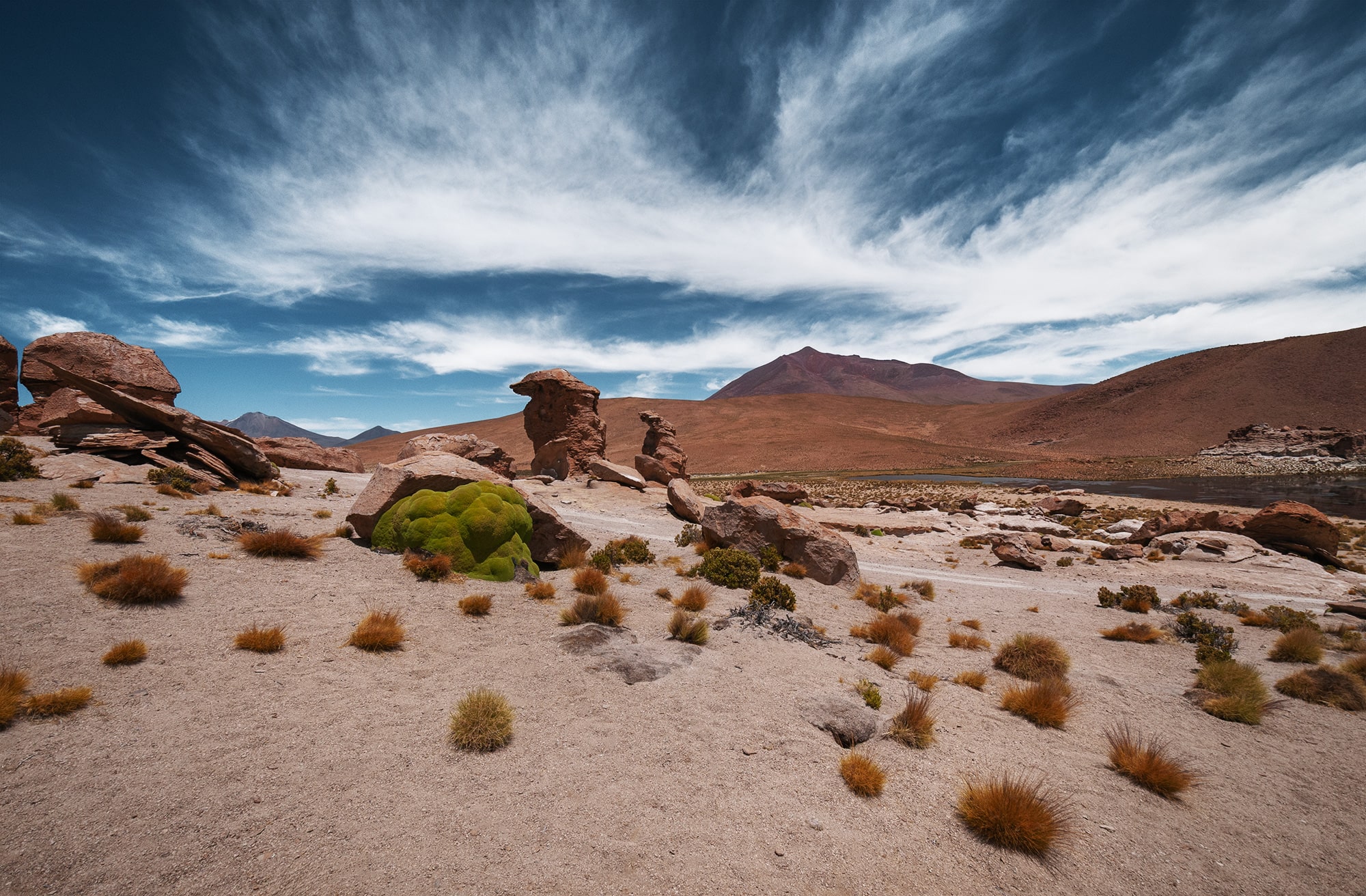
Bolivian Altiplano: wild silence
📍Somewhere between San Pedro de Atacama and the Salar de Uyuni
The next step of my journey was the Bolivian Altiplano. I had booked a five-day tour with a local agency, traveling in a 4×4 with a small group. We were supposed to visit the famous lagunas altiplánicas, but due to a strike, the park was closed. So our driver took us through other parts of this vast, remote region. And honestly, it was just as breathtaking.
There is nothing up there. No signs, no real roads, just desert tracks, volcanoes, strange rock formations, and a few scattered villages. I couldn’t even tell you exactly where I took this photograph. Somewhere between San Pedro and the Salar, in the middle of nowhere.
What caught my eye was a large volcanic rock with unusual green textures, a kind of hard moss clinging to the surface. Everything felt surreal. I had never seen landscapes like this before, and every corner of the journey seemed more impressive than the last.
Best time to photograph
Since I was on a group tour, I couldn’t choose the timing for each location. Most of my shots were taken in the middle of the day, but I still loved the results. The light was harsh, but the shadows were deep, the clouds were dramatic, and the land had a raw intensity that worked even outside golden hour. Still, I often dream of going back with a private guide, just to experience it all at sunrise or sunset.
Access and tips
I highly recommend going with a guide or a local agency. The roads are unmarked desert tracks and the distances are long. Back in 2012, there was no chance I could have navigated the Altiplano on my own. Maybe things have changed, but even now, this is not a region to explore without experience and preparation.
✅ Bring plenty of layers. Temperatures vary a lot and the wind can be strong even in the sun.
✅ Dust is everywhere. Keep your gear protected and avoid lens changes during the drive.
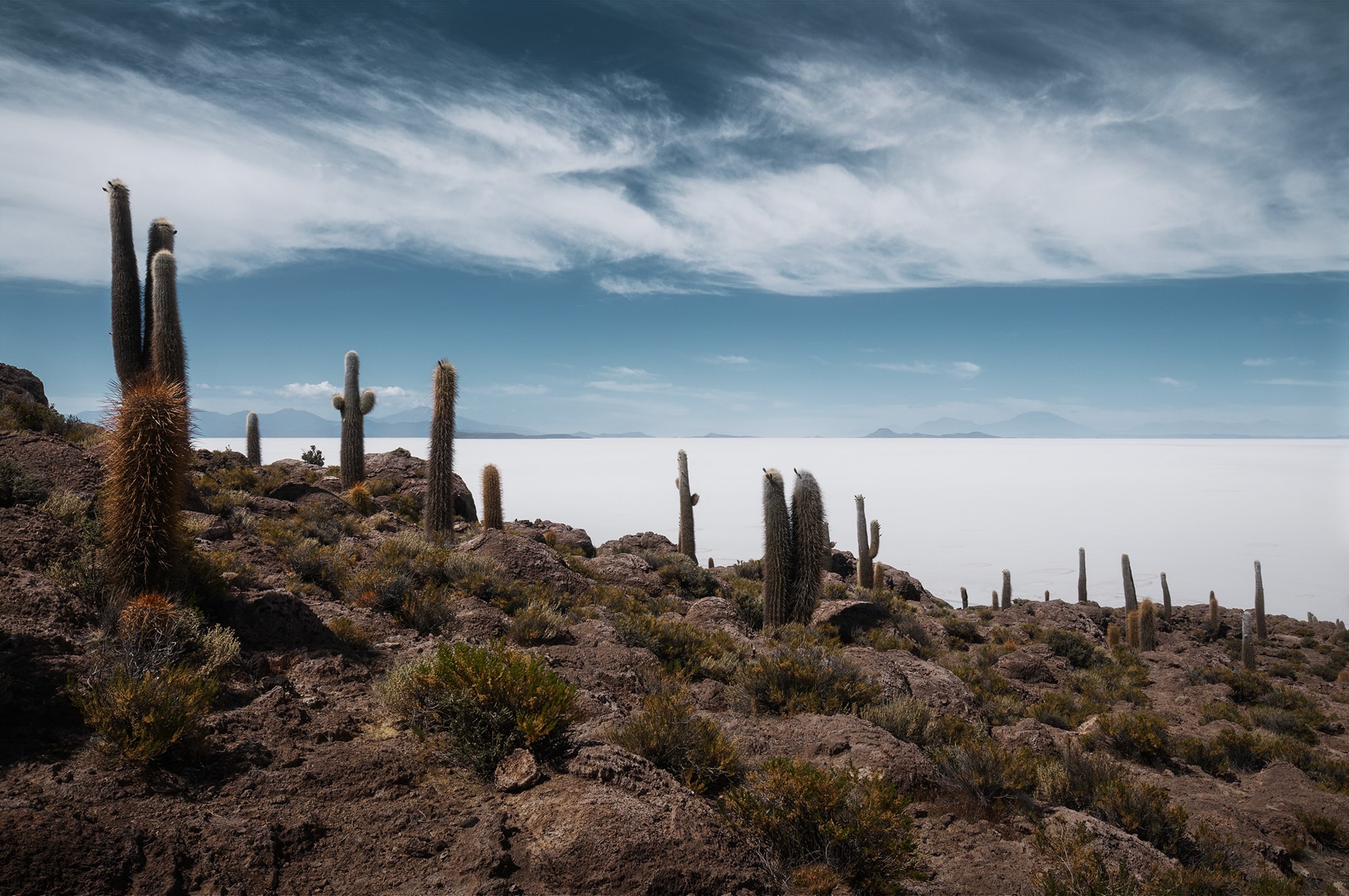
Salar de Uyuni: infinite white from Incahuasi
📍Isla Incahuasi, Salar de Uyuni, Bolivia
The second goal of this Bolivian trip was to see the iconic Salar de Uyuni. I wasn’t visiting during the rainy season, so the salt flat was completely dry. But even without the famous mirror effect, it was absolutely breathtaking. You definitely need sunglasses up there. The light is incredibly strong and reflects off the salt in every direction.
The Salar de Uyuni is the largest salt flat in the world. Once part of a prehistoric lake, it slowly dried up over time, leaving behind this immense crust of white salt and minerals. Standing on it feels like walking on another planet.
For this photograph, we stopped at Isla Incahuasi, a rocky island covered in towering cacti. From the top, the view is spectacular. You’re completely surrounded by white, flat salt all the way to the horizon, with the Andes in the distance and clouds floating above like brushstrokes. I loved how the cactus added scale and contrast to the scene. This was one of the moments where I truly felt how small we are in such vast landscapes.
➜ Salar de Uyuni
➜ Isla Incahuasi
Best time to photograph
We arrived around midday, so the sun was harsh, but the scene still worked beautifully. The deep blue of the sky, the soft, stretched clouds, and the pure white salt created a high-contrast palette that was perfect for minimalist compositions. That said, sunrise or sunset would probably bring even more magic, with long shadows and golden tones.
Access and tips
We reached the island by jeep and spent about an hour exploring it. The climb to the top is short but includes a few stairs, so bring water and take your time. The path is well maintained and easy to follow. Even with the strong light and altitude, it’s a very accessible location.
✅ Wide-angle lenses work great for the salt flat.
✅ Don’t forget sun protection. The altitude and reflection make it easy to get burned.
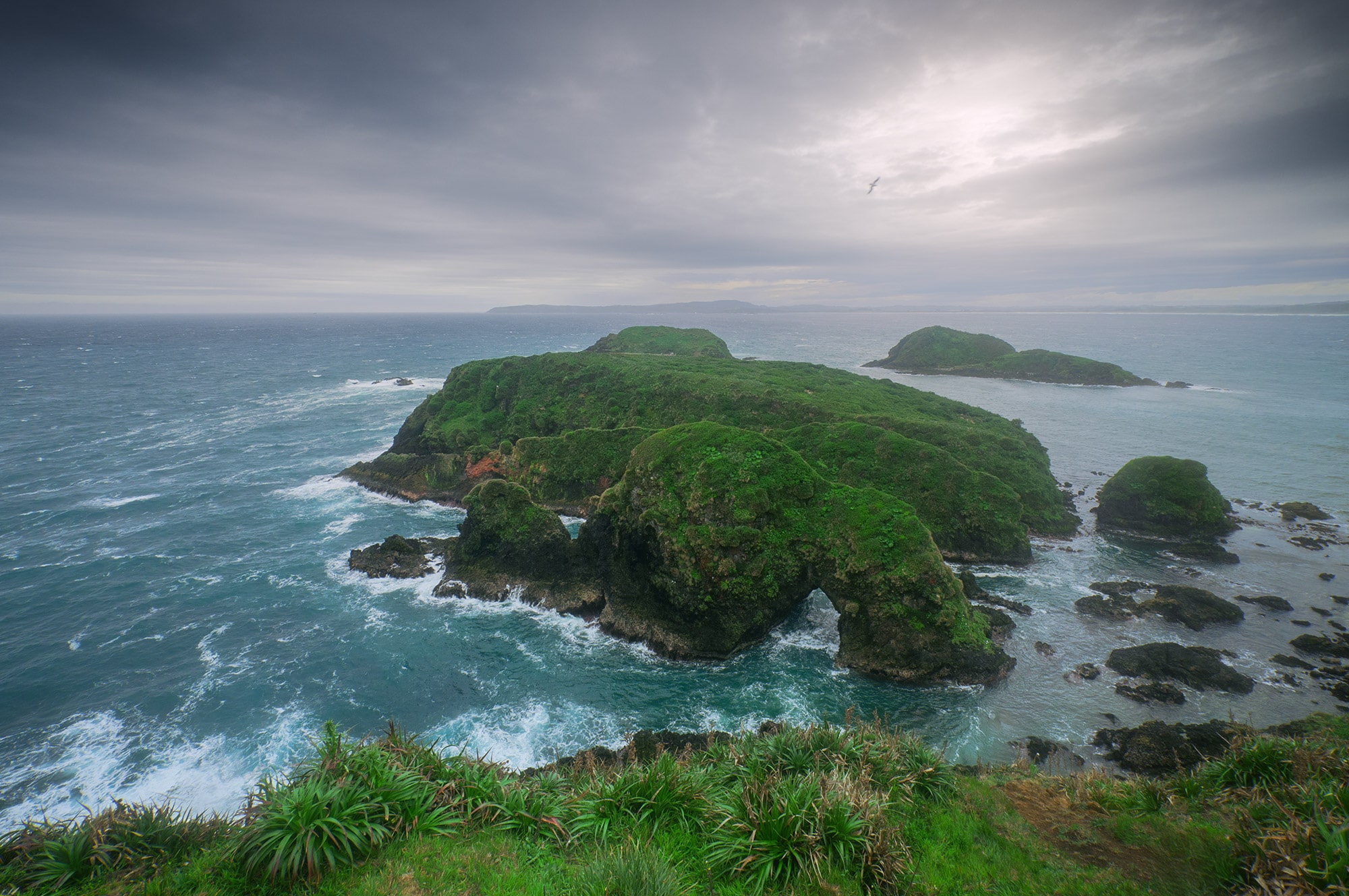
Chiloé: green winds at Muelle El Caleuche
📍Mirador Muelle El Caleuche, Playa Puñihuil
After the dry heat of the Atacama, I was longing for something different. I didn’t have enough time to explore Patagonia, so I chose to head to Chiloé. I had read about its marine legends and imagined it as a kind of Chilean Ireland: rainy, wild, and green. A perfect contrast with the Altiplano.
My stay was short, but one place really stood out to me. The Monumento Natural Islotes de Puñihuil, seen from the mirador called Muelle El Caleuche. This beach is known for its tiny penguins that nest there during part of the year. But what struck me most was the view from above. Mossy rocks emerging from the ocean, surrounded by wind, waves, and mist.
I had terrible weather for most of my stay, but just for two hours, the rain stopped. It was the perfect chance to head out with my camera. Despite the wind blowing so hard I had to hold on to the railing, the sky was heavy and dramatic. It matched the island’s mood perfectly.
➜ Playa Puñihuil
➜ Mirador Muelle El Caleuche
Best time to photograph
On a calm day, I imagine sunset would be beautiful, especially if the clouds break open. But moody weather can be just as rewarding here. It adds mystery and emotion. I recommend a wide-angle lens for the overall scene. And if you’re lucky enough to visit during penguin season, bring a telephoto lens for the boat tour.
Access and tips
Drive to Playa Puñihuil and follow the short path up the hill on the southern side of the beach. A few steps through the grass lead you to the viewpoint. It’s an easy walk, but it can be muddy or slippery. Check the tide before you go, and don’t forget your waterproof jacket and windbreaker. The weather changes quickly.
✅ Moody skies add emotion to the scene
✅ Don’t forget a windbreaker and waterproof shoes
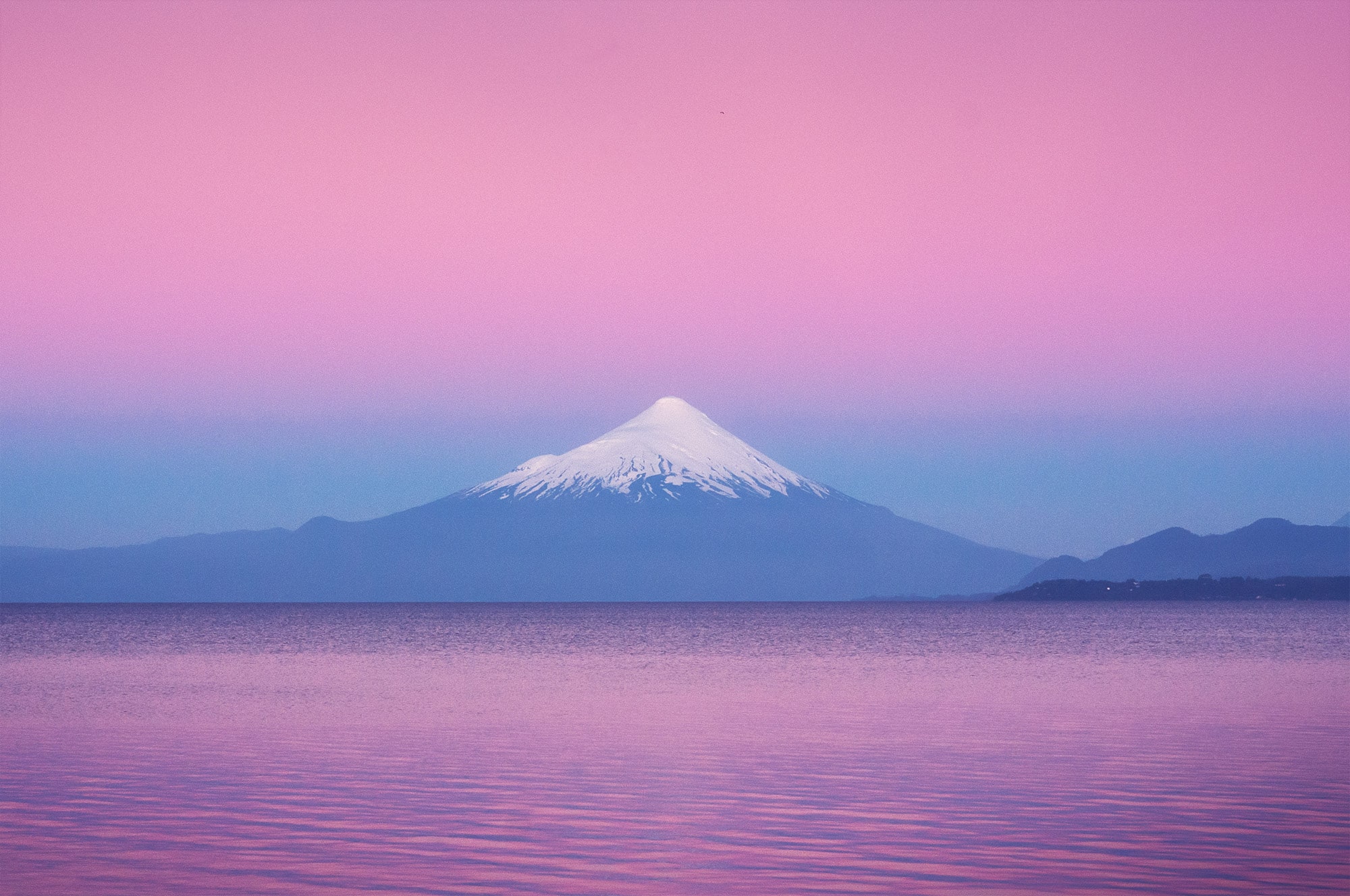
Frutillar: Osorno at blue hour
📍Lago Llanquihue, Chile
Before leaving for Chile, someone recommended I visit the town of Frutillar, so I booked a few nights there. I wasn’t staying long, but my goal was clear: I wanted to see the volcano Osorno. It was the very first volcano I had ever seen, and I was excited to enjoy the view as much as possible.
This photo was taken as I returned from a day trip on the volcano itself. My bus had just dropped me off at the station, and I decided to walk straight to the lakeside to watch the sunset. The lake is called Lago Llanquihue, and the view from the little beach in Frutillar is just stunning.
I arrived just after the sun had dipped below the horizon, and suddenly the sky turned pink and violet. I remember thinking, “What are these colors?!” It was magic. I didn’t even have my tripod with me, so I had to shoot handheld. But in the end, this turned out to be one of my favorite images from the trip. I know the composition is simple, but the moment was unforgettable.
Best time to photograph
I would say the most beautiful light is during golden hour, blue hour, or sunrise. The lake stays calm and the mountain appears clearly in the distance. Try to avoid harsh midday light if you can.
Access and tips
The beach in Frutillar is very easy to access and quite small. Since it’s a lakeshore and not the ocean, there are no tides to worry about. Unless there’s a storm, it’s a peaceful place to photograph and reflect.
✅ Check out the forecast, the volcano is often hidden in clouds
✅ Go there for golden or blue hour
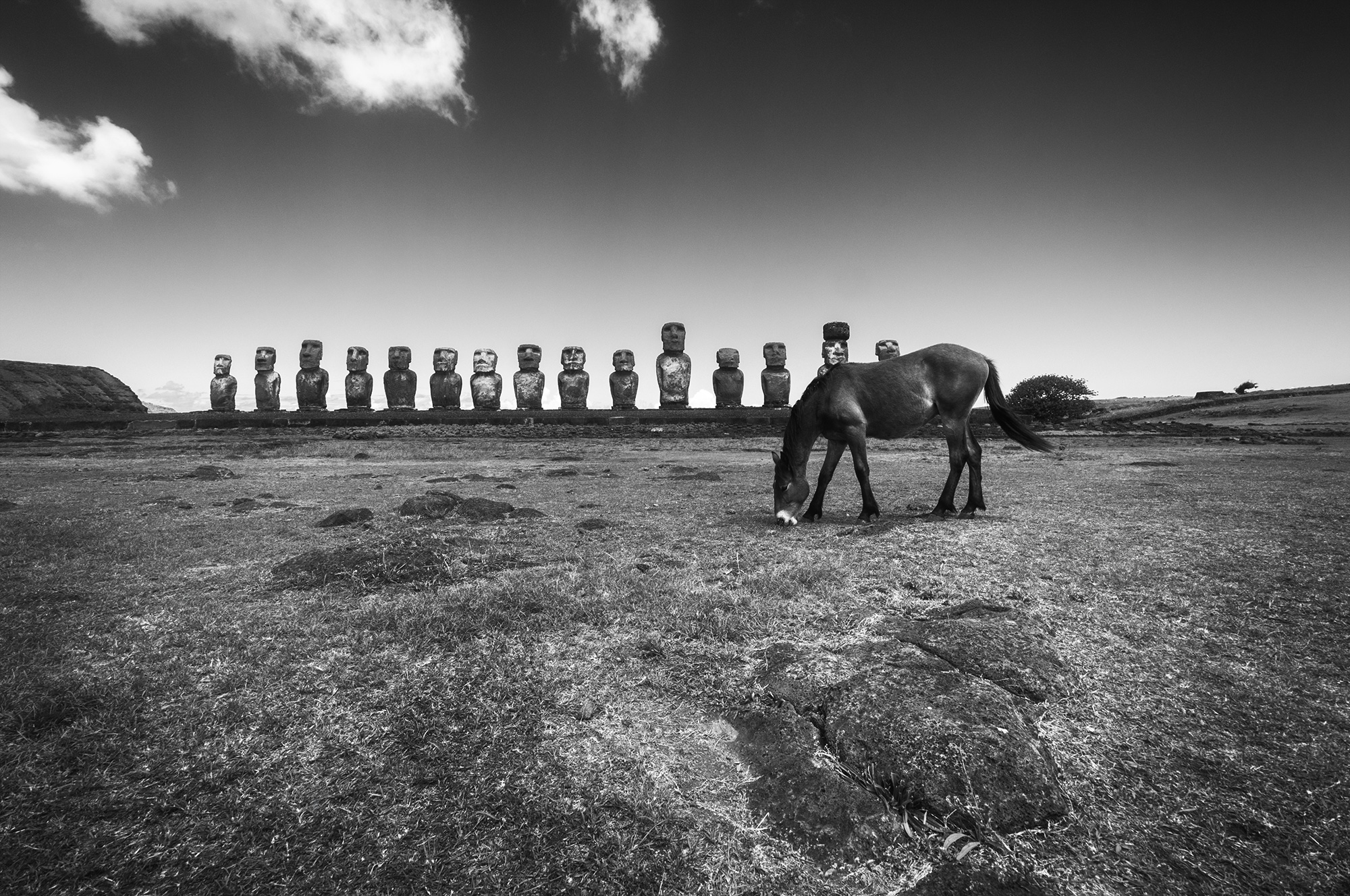
Easter Island: moai and wild horses at Ahu Tongariki
📍Easter Island
The final stop of my one-month solo journey through Chile was Easter Island. Honestly, it really feels like the end of the world. It takes several hours of flight from Santiago, and there is absolutely nothing around. Just this mysterious island in the middle of the Pacific. Pretty mind-blowing when you think about it.
Of course, I wanted to see the famous moai statues. And I did. You’ll notice that many of them have fallen, which gives the place a unique and slightly melancholic feel. But what surprised me most was the presence of semi-wild horses roaming freely around the island. I’ve always loved horses, so I was thrilled.
When I visited Ahu Tongariki, on the southeastern side of the island, I came across a small group of horses walking around the statues. It felt like a gift. I took the opportunity to frame them together in one composition: the ancient moai and these living, free-moving creatures. It’s one of the more original images I brought back from this trip.
➜ Car park
Best time to photograph
Sunrise is the most iconic time to visit Ahu Tongariki. The sun rises right between the statues, creating a dramatic and spiritual scene. But for my part, I actually preferred the black and white photo I took in the middle of the afternoon, with soft light and strong shadows. Sunset could also be interesting when the light hits the moai from the side.
Access
The site is very easy to access by car. There’s a small parking area nearby, and the rest is a flat walk. No effort is required to reach the viewpoint, and the open space allows you to play with different compositions depending on the light and where the horses are.
✅ Early morning light is magical, but any time of day can surprise you
What this journey taught me
This solo trip through Chile and Bolivia was not just about ticking off places on a map. It was about discovering vast landscapes, quiet moments, and the kind of light that stays with you long after the shutter clicks.
It taught me that beauty is everywhere, even when things don’t go as planned. That you don’t need golden hour to create a meaningful image. That sometimes, the best photo happens when your tripod is packed away and the sky turns violet without warning.
I learned to let go of control, to trust my instincts, and to enjoy the journey. These remote places made me feel both small and connected, and reminded me why I love photography in the first place.
This adventure is part of the reason I still seek silence, light, and emotion in every landscape I shoot today.
And most of all, enjoy the moment. Happy shooting!
Published on January 7, 2026 by Jennifer Esseiva