Pico Island is one of the most photogenic islands of the Azores, yet it often surprises visitors. When I first arrived, I imagined two iconic scenes: the red windmills along the coastline and the perfectly framed view of Mount Pico rising above Lagoa do Capitão.
But Pico quickly revealed much more. Beyond its postcard views, the island offers dramatic crater lakes hidden in the highlands, volcanic slopes shaped by shifting weather, and the extraordinary lava vineyards of Criação Velha, where vines grow between black stone walls facing the Atlantic.
Pico was part of a wider 10-day landscape photography journey across the Azores, where I explored several islands with my camera.
As a landscape photographer, I was drawn to the contrast between calm mornings, fast-moving fog and intense sunsets. In this guide, I share the best photography spots in Pico Island, along with practical insights to help you capture its unique light and atmosphere.
Quick guide: 8 landscapes to photograph in Pico Island (Azores)
A few days across volcanic highlands, crater lakes, Atlantic coastlines and lava vineyards. Here are eight powerful photography locations that combine fog, light and raw textures on Pico Island:
➜ Sunsets at Lajes do Pico
➜ Sunrise and fog at Lagoa do Capitão
➜ Lagoa do Paúl in the highlands
➜ Lagoa do Caveiro with hydrangeas
➜ Lagoa da Rosada above the plateau
➜ Lagoa do Peixinho and its emerald water
➜ Terra Alta crater
➜ Criação Velha lava vineyards
If you are planning a broader trip through the Azores, you might also enjoy my guide to Terceira Island, where landscapes, light and atmosphere offer a completely different photographic experience.
➜ Discover my 10-day Azores photography itinerary (Pico, São Miguel & Terceira)
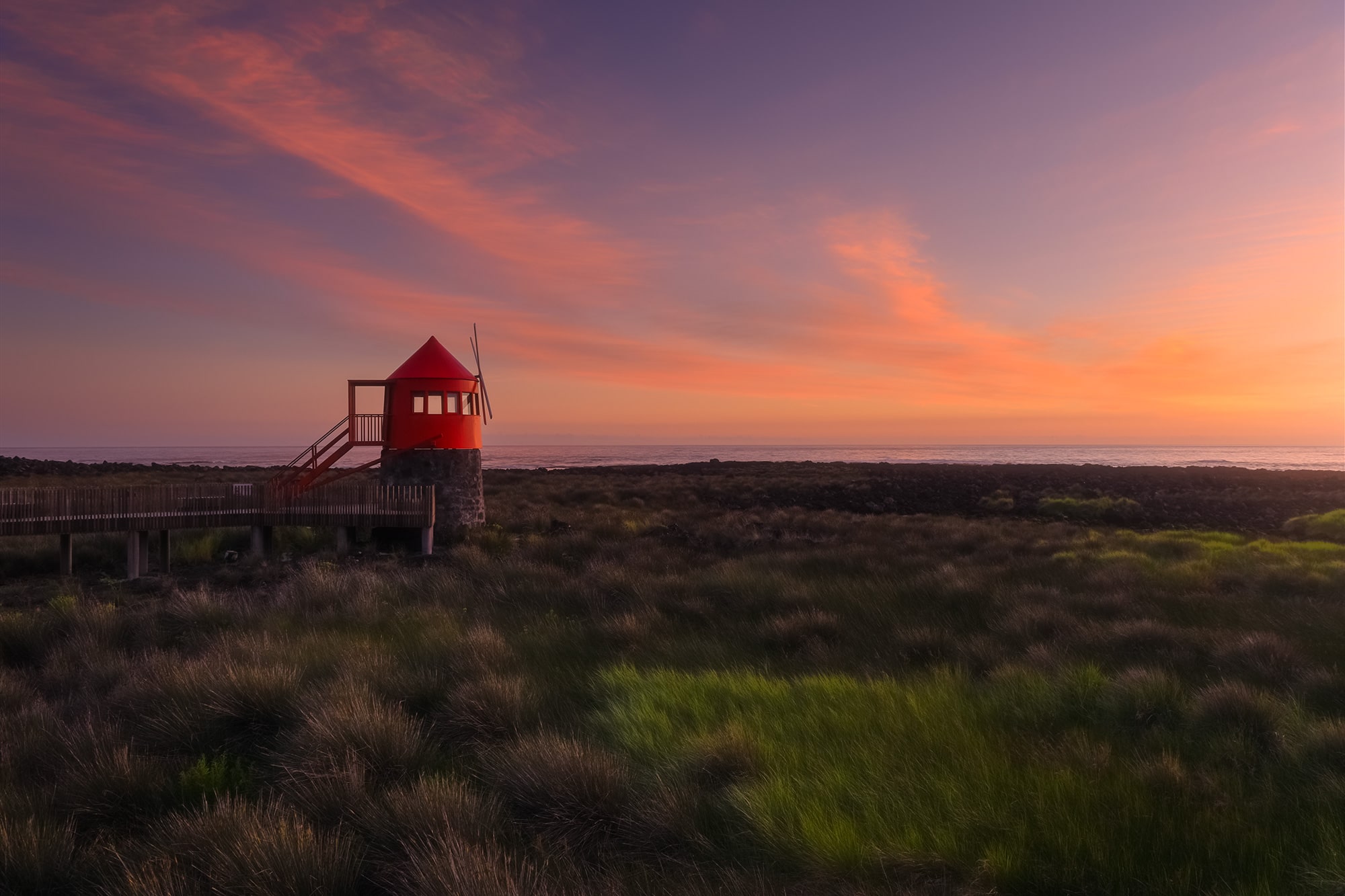
Shot with Nikon D810 · 24–70mm
Lajes do Pico: Sunset at the Red Windmill
Lajes do Pico is one of the most iconic coastal locations on the island, known for its red windmills facing the Atlantic Ocean. This spot offers a clean and minimalist composition, especially at sunset, when the light softens and the colors become more delicate.
How to get there
The red windmill, called Moinho do Juncal, is located right by the sea and is easily accessible from the waterfront road. There is a small parking area just in front, making it a very convenient stop.
If you plan to shoot at sunset, arriving a bit earlier will give you time to explore different angles along the coastline.
➜ Parking location
The story behind this image
When planning my stay in Pico, I knew I wanted to photograph one of these iconic red windmills at sunset. On our first evening, we decided to have dinner nearby to make sure we wouldn’t miss the light. And everything happened very quickly. Just after we finished eating, the sky started to shift into soft pink and orange tones.
For this image, I chose a simple and balanced composition, keeping the windmill centered against the ocean and the open sky. I loved the contrast between the pastel colors, the deep red of the windmill, and the green grass in the foreground.
Why I liked this spot for photography
✅ Iconic red windmill creating a strong focal point
✅ Perfect west-facing orientation for sunset

Shot with the DJI mini 2
Lagoa do Capitão: Sunrise and Fog in Pico’s Highlands
Located on the central plateau of Pico Island, Lagoa do Capitão is one of the most iconic photography spots in the Azores. With Mount Pico rising in the background and open views across the highlands, it offers some of the most dramatic and ever-changing landscapes on the island.
How to get there
Lagoa do Capitão is located in the highlands of Pico Island and can be reached easily by car via the central plateau road. There is a small parking area at the end of the road, and the lake is just a short walk away.
The story behind this image
During our second morning on the island, I decided to drive up to Lagoa do Capitão before sunrise. From our Airbnb, I couldn’t tell if the sky was clear, but we took the chance anyway.
We arrived just a few minutes before sunrise, with barely enough time to reach the viewpoint. As the first light touched the landscape, Mount Pico slowly turned orange, standing out beautifully above the highlands.
From above, the drone revealed the full scene, the lake, the rolling hills, and even a few cows scattered across the fields. It felt calm and perfectly balanced. And then, just as quickly, the fog rolled back in and everything disappeared again.
I also came back later that day in completely different conditions. This time, the lake was entirely hidden in thick fog. Instead of focusing on Mount Pico, I turned my attention to the twisted trees around the crater. In the mist, they became the main subject, creating a much more intimate and moody atmosphere.
Why I loved this spot for photography
✅ Stunning red tones on the mountains at sunrise
✅ Peaceful atmosphere with no one around early in the morning

Shot with Nikon D810 · 24–70mm
Lagoa do Capitão: Sunrise and Fog in Pico’s Highlands
Located on the central plateau of Pico Island, Lagoa do Capitão is one of the most iconic photography spots in the Azores. With Mount Pico rising in the background and open views across the highlands, it offers some of the most dramatic and ever-changing landscapes on the island.
How to get there
Lagoa do Capitão is located in the highlands of Pico Island and can be reached easily by car via the central plateau road. There is a small parking area at the end of the road, and the lake is just a short walk away.
The story behind this image
During our second morning on the island, I decided to drive up to Lagoa do Capitão before sunrise. From our Airbnb, I couldn’t tell if the sky was clear, but we took the chance anyway.
We arrived just a few minutes before sunrise, with barely enough time to reach the viewpoint. As the first light touched the landscape, Mount Pico slowly turned orange, standing out beautifully above the highlands.
From above, the drone revealed the full scene, the lake, the rolling hills, and even a few cows scattered across the fields. It felt calm and perfectly balanced. And then, just as quickly, the fog rolled back in and everything disappeared again.
I also came back later that day in completely different conditions. This time, the lake was entirely hidden in thick fog. Instead of focusing on Mount Pico, I turned my attention to the twisted trees around the crater. In the mist, they became the main subject, creating a much more intimate and moody atmosphere.
Why I loved this spot for photography
✅ Graphical leading line with the stone wall
✅ The twisted tree adding character to the scene
Shot with Nikon D810 · 24–70mm
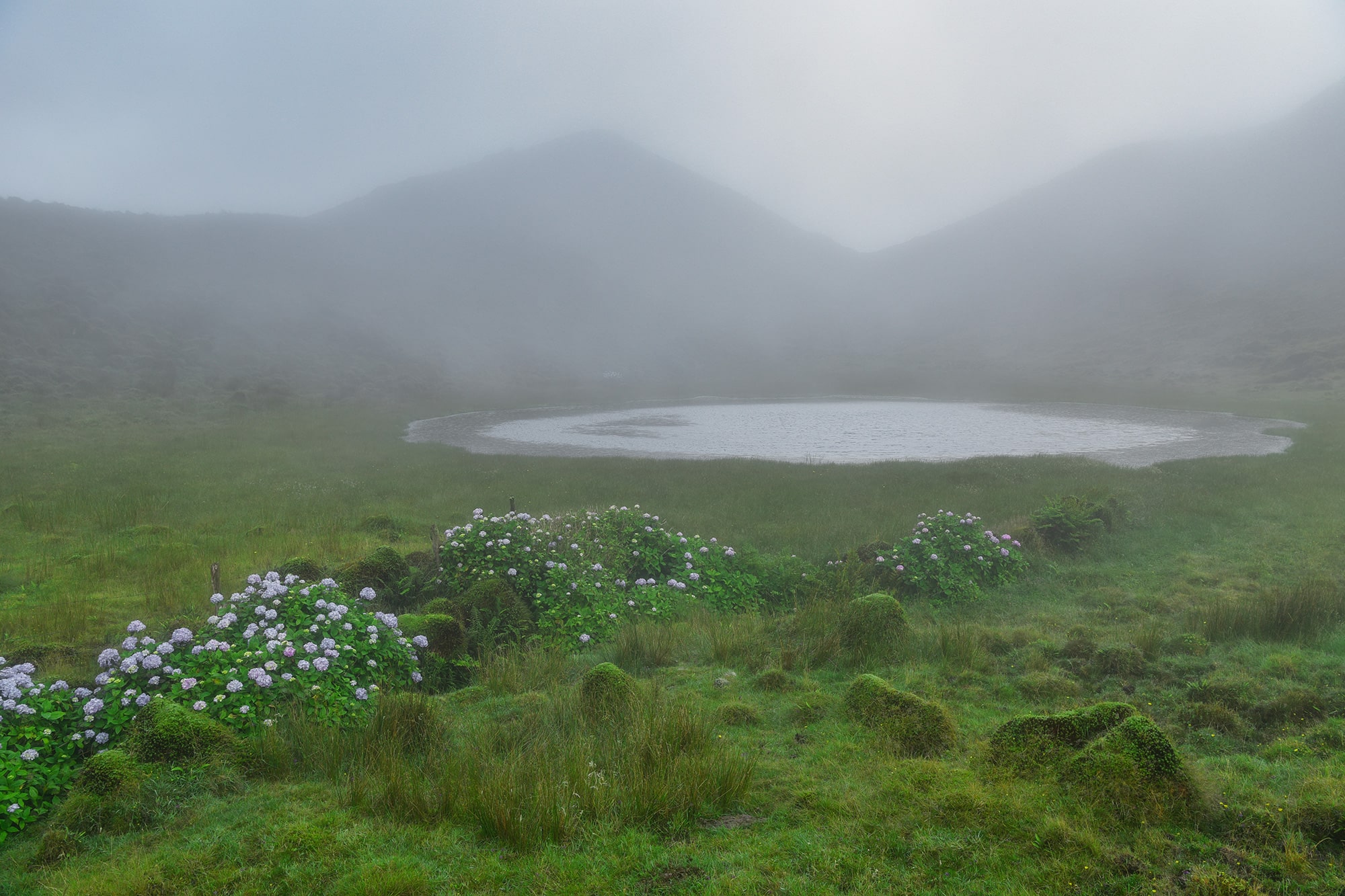
Lagoa do Caveiro: Purple hydrangeas in the mist
Located on Pico’s volcanic plateau, Lagoa do Caveiro is one of the many small crater lakes scattered across the highlands. Smaller and more discreet than Lagoa do Capitão, it offers a quieter and more intimate setting for landscape photography.
How to get there
Lagoa do Caveiro is located along the highland road crossing Pico Island. The road is narrow and not in perfect condition, so driving slowly is recommended.
You can park on the right side near the lake, and the viewpoint is just a short walk away, if the lake is not completely hidden in fog.
The story behind this image
After Lagoa do Paúl, we continued our drive across the highlands toward Lagoa do Caveiro. The weather changed quickly along the way. By the time we arrived, the fog had completely taken over the landscape, and the lake was almost invisible. For a moment, I even wondered if it had dried out.
We decided to wait. After about half an hour, the shape of the lake slowly began to reappear through the mist. For this composition, I wanted to bring together three elements that feel very characteristic of the Azores: the purple hydrangeas in the foreground, the small crater lake, and the soft volcanic slopes surrounding it.
The fog blurred the edges of the landscape and transformed the scene into something quiet and almost unreal.
Why I loved this spot for photography
✅ Purple hydrangeas in the foreground
✅ Fog creating a soft and atmospheric mood

Shot with Nikon D810 · 24–70mm
Lagoa da Rosada: A lake emerging from the fog
Located very close to Lagoa do Caveiro, Lagoa da Rosada sits along the same highland road crossing Pico’s volcanic plateau. It is easy to miss, especially when the weather changes quickly in the highlands.
How to get there
On the left side of the road, there is a small parking area from which you can easily walk to the edge of the crater to see the lake.
➜ Parking location
The story behind this image
After Lagoa do Caveiro, we drove back toward Lagoa da Rosada. As expected, when we arrived, the lake was completely hidden in fog. We couldn’t see anything at all.
I really wanted to photograph this one, so we decided to wait again. After more than half an hour, the fog slowly began to lift. From near the parking area, the lake finally appeared below us.
It was actually the only crater lake that day that we could photograph from above without using the drone, which made it even more special.
What I liked most was the natural path on the left side of the frame. It added depth and a sense of scale, guiding the eye toward the lake as it gradually emerged from the mist.
Why I loved this spot for photography
✅ Elevated view over the crater lake
✅ The path creating depth and scale
✅ Fog adding atmosphere and mystery

Shot with Nikon D810 · 24–70mm
Lagoa do Peixinho: Emerald water revealed through the fog
Lagoa do Peixinho was the last crater lake on my list in the highlands of Pico Island. I had heard that, under the right conditions, the water can turn an intense emerald green, which made me really curious to see it.
When we arrived, there was absolutely nothing to see. The lake was completely hidden in fog, and there was no phone reception either, so I couldn’t check Google Maps to make sure we were at the right place. We parked on a small open space along the road above the crater, hoping we were in the right place.
And we waited, waited and after more than an hour, the fog lifted for barely three minutes. The lake suddenly appeared below us, glowing in a deep emerald tone. I quickly framed the shot from above before the mist closed in again. I was so happy we hadn’t left.
How to get there
There is a parking area near Lagoa do Peixinho, but I personally stopped on the side of the road above the crater to get a higher perspective. From there, you can look down toward the lake when the fog allows it.
➜ Parking location
The story behind this image
When we arrived, there was absolutely nothing to see. The lake was completely hidden in fog, and there was no phone reception, so I couldn’t even check if we were at the right place.
We parked on a small open space along the road above the crater and decided to wait, hoping the fog would lift. And we waited… for more than an hour.
Then, suddenly, the fog opened for just a few minutes. The lake appeared below us, glowing in a deep emerald tone. I quickly framed the shot from above before the mist closed in again. It lasted maybe three minutes, but it was enough. I was so happy we hadn’t left.
Why I loved this spot for photography
✅ Possibility of rare emerald-colored water
✅ Elevated view from the road above
✅ Unpredictable weather creating tension and reward
Shot with the DJI mini 2
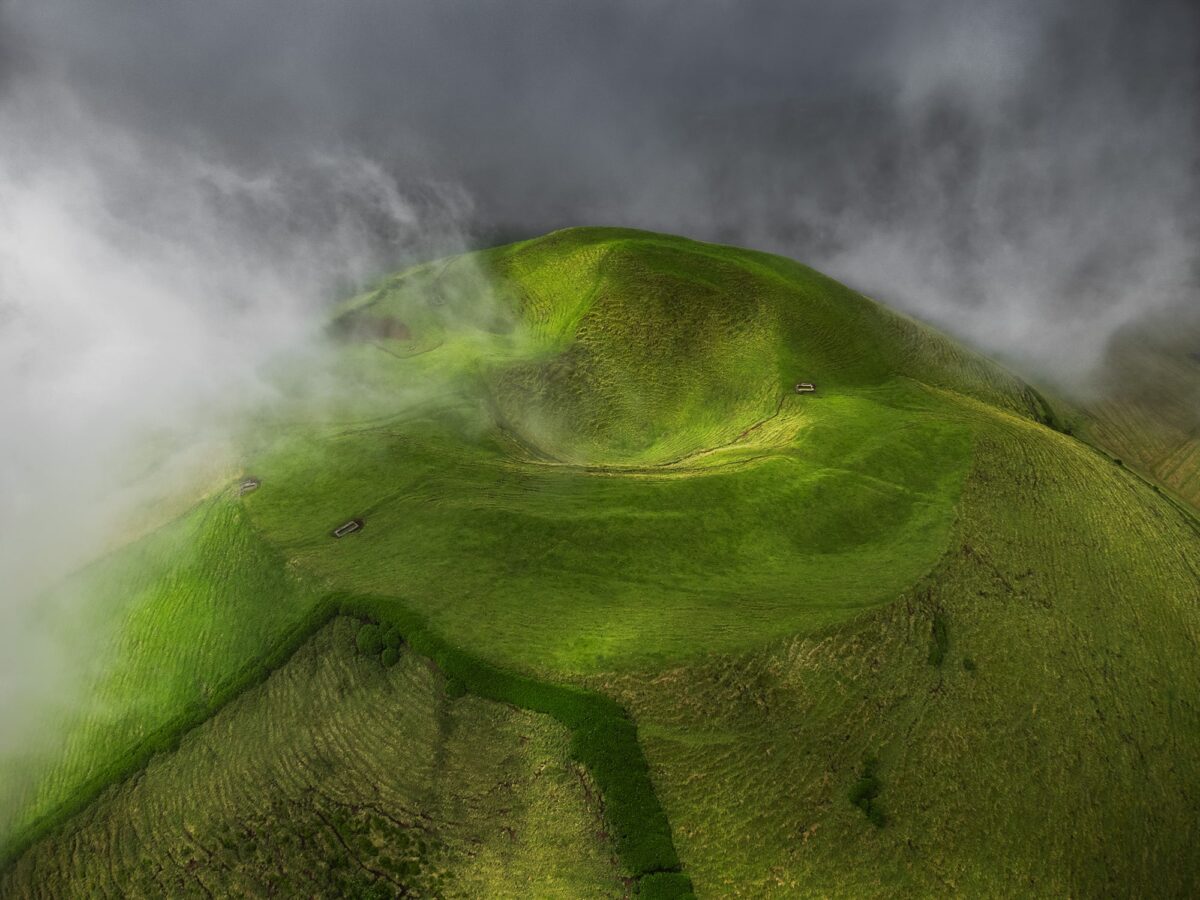
An unexpected crater in Terra Alta
Located in the Terra Alta highlands on the east side of Pico Island, this volcanic crater was not even on my original list. I couldn’t tell you its exact name or precise location. It was simply one of those unexpected discoveries that happen when you take the time to explore.
How to get there
This crater is located somewhere along the central plateau road in the Terra Alta highlands. There are occasional roadside spaces where you can safely stop. Weather conditions change quickly in this area, so visibility can shift within minutes.
The story behind this image
We were driving down from the highlands, slowly leaving the fog behind us. The grass was incredibly green, and I could see soft volcanic shapes appearing in the distance.
At the first safe spot along the road, we stopped, and I immediately launched the drone. From the ground, I couldn’t see the top of the crater at all, so I had no idea what to expect. But once in the air, the shape revealed itself.
A perfectly sculpted, grass-covered crater, with clouds moving gently around it. The fog was drifting along the edges, revealing and hiding parts of the landscape at the same time. It was completely unplanned, instinctive, and one of those moments where everything just comes together.
Why I loved this spot for photography
✅ Perfect circular volcanic shape
✅ Beautiful green grass textures
✅ Moving fog adding depth and mystery
Shot with the DJI mini 2
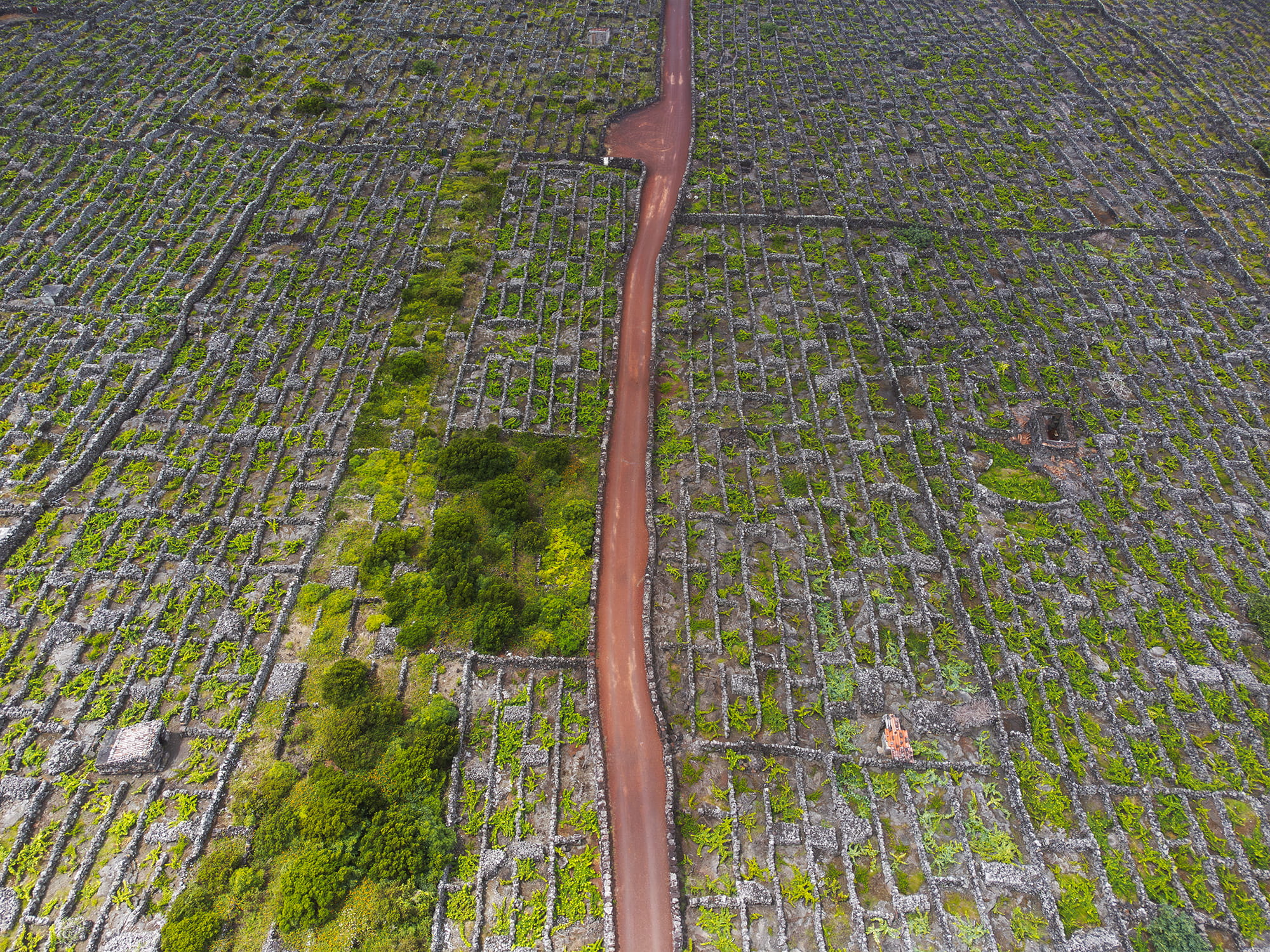
Criação Velha: Lava vineyards shaped by the volcano
Criação Velha was one of the places I really wanted to see on Pico Island. The vines grow in small rectangular plots surrounded by black volcanic stone walls, creating a unique landscape shaped by both nature and human adaptation.
How to get there
The vineyards of Criação Velha are easily accessible by car. There are several small parking areas along the road where you can safely stop and explore on foot. If you plan to fly a drone, make sure to check local regulations and weather conditions, as wind can be strong along the coast.
➜ The vineyards of Criação Velha
The story behind this image
From the ground, the vineyard already feels impressive, but I knew that the drone would reveal something completely different.
Once in the air, the patterns became much stronger. The small stone squares seemed endless, stretching toward the ocean and creating a very graphic composition.
What caught my eye the most was the red dirt road cutting through the vineyard. It created a strong leading line and stood out beautifully between the green vines and the dark lava stones. From above, the whole scene almost felt abstract, more like a texture than a landscape.
Why I loved this spot for photography
✅ Unique volcanic stone patterns
✅ Strong geometric composition from above
✅ Beautiful contrast between red road, black lava stones and green vines
✅ A landscape shaped by both nature and human adaptation
Pico Island for Photography, Final Thoughts
Pico surprised me in the best way. It offered some of the most magical light of my trip across the Azores. I captured unforgettable sunsets over the Atlantic, a golden sunrise at Lagoa do Capitão, moody crater lakes wrapped in fog, and the striking geometry of lava vineyards shaped by centuries of adaptation.
Honestly, I hadn’t expected much from this island. I thought it would simply be a quiet stop. Instead, it became the most inspiring place of the journey. The constantly changing weather, the deep greens of the highlands, the black volcanic stone, and even the famous vineyards of Pico all added layers to the experience.
Of course, I was lucky. The light matched exactly the kind of moody atmosphere I love. I also met travelers who only experienced rain and thick fog. That unpredictability is part of Pico. And part of why photographing it feels so rewarding.
If you decide to explore Pico Island with your camera, give yourself time. Wait for the fog to lift. Trust your instinct. Sometimes the best moments are the ones you didn’t plan.
If you would like to see more images from this trip, you can explore my full Azores photography gallery, where I share additional landscapes captured across the islands.
And most of all, enjoy the moment. Happy shooting!
Published on February 20, 2026 by Jennifer Esseiva